Aug 16, 2022

Rising Heat

Political Climate Change isn't any less real or less dangerous than the other kind.

MSNBC - Trump threatened AG Garland


Let's be clear. Trump did not try to get with Garland to ask him how he (Trump) could help cool things down.

Daddy State Awareness - Rule 3

Every prediction of some dire consequence is a threat.
Either they intend to do some shitty thing, or cause some shitty thing to happen - or it's a signal that they’re already doing it or causing it - in an attempt to coerce us into doing what they want.

On The Other Hand

Here's an Op/Ed piece at NYTimes put up by a couple of brainy guys, saying the Carbon Capture part of The Inflation Reduction Act is not the good thing we all thought it was.

I'll stop a little short of agreeing the whole thing is a boondoggle for the Dirty Fuels Gang, because its inclusion may well be the reason we got Joe Manchin to sign on to it.

Also, we have to start somewhere, and it should be pretty obvious that starting "way over there" where the lefties want us to be wasn't working, so let's get something going and see what happens. If we can keep Dems in place, we could get a chance to fix it down the road a ways - assuming we do get started, and that "down the road a ways" isn't too far.


NYT: (pay wall)

Every Dollar Spent on This Climate Technology Is a Waste

Dr. Harvey is a professor of environmental engineering at the Massachusetts Institute of Technology. Dr. House is the chief executive officer of KoBold Metals, a metals exploration company.

The technology called carbon capture and storage is aptly named. It is supposed to capture carbon dioxide emissions from industrial sources and pump them deep underground. It was a big winner in the climate provisions of the Inflation Reduction Act passed by Congress last week.

What the technology, known as C.C.S., also does is allow for the continued production of oil and natural gas at a time when the world should be ending its dependence on fossil fuels.

The Inflation Reduction Act, which President Biden said he will sign this week, does more to cut fossil fuel use and fight climate change than any previous legislation by expanding renewable energy, electric cars, heat pumps and more. But the law also contains a counterproductive waste of money, backed by the fossil fuel industry, to subsidize C.C.S.

Fifteen years ago, before the cost of renewable energy plummeted, carbon capture seemed like a good idea. We should know: When we launched a start-up 14 years ago — the first privately funded company to make use of the technology in the United States — the idea was that the technology could compete as a way to produce carbon-free electricity by capturing the carbon dioxide emissions emitted by power plants and burying them. But now it’s clear that we were wrong, and that every dollar invested in renewable energy — instead of C.C.S. power — will eliminate far more carbon emissions.

Even so, this technology has broad political support, including from Senator Joe Manchin of West Virginia, an ally of the coal industry, because it enables the continued extraction and burning of fossil fuels while also preventing the resulting carbon dioxide from entering the atmosphere. Industry campaigns such as “Clean Coal” have also promoted the technology as something that could ramp up quickly to bridge the gap to the deployment of large-scale renewable energy. But by promoting C.C.S., the fossil fuel industry is slowing the transition away from fossil fuels.

Under the Inflation Reduction Act, facilities using this technology will be eligible for generous tax credits provided they break ground by the end of 2032 — an extension of the current deadline of 2025. Those benefits come on top of $12 billion in government investments in C.C.S., as well as technology that would pull carbon dioxide directly from the air, which were included in the infrastructure bill signed by President Biden last fall.

C.C.S. is seen as a solution to the emissions problem for a range of industries, from fossil-fuel-fired electricity generating plants to industrial facilities that produce cement, steel, iron, chemicals and fertilizer.

Where C.C.S. has been most widely used in the United States and elsewhere, however, is in the production of oil and natural gas. Here’s how: Natural gas processing facilities separate carbon dioxide from methane to purify the methane for sale. These facilities then sometimes pipe the “captured” carbon dioxide to what are known as enhanced oil recovery projects, where the carbon dioxide is injected into oil fields to extract additional oil that would otherwise be trapped underground.

Of the 12 commercial C.C.S. projects in operation in 2021, more than 90 percent are engaged in enhanced oil recovery, using carbon dioxide emitted from natural gas processing facilities or from fertilizer, hydrogen or ethanol plants, according to an industry report. That is why we consider these ventures oil or natural gas projects, or both, masquerading as climate change solutions.

The projects are responsible for most of the carbon dioxide now being sequestered underground in the United States. Four projects that do both enhanced oil recovery and natural gas processing account for two-thirds to three-quarters of all estimated carbon sequestered in the United States, with two plants storing the most. But the net effect is hardly climate friendly. This process produces more natural gas and oil, increases carbon dioxide emissions and transfers carbon dioxide that was naturally locked away underground in one place to another one elsewhere.

In an effort to capture and store carbon dioxide from fossil-fuel-burning power plants, the Department of Energy has allocated billions for failed C.C.S. demonstration projects. The bankruptcy of many of these hugely subsidized undertakings makes plain the failure of C.C.S. to reduce emissions economically.

The Kemper Power Project in Mississippi spent $7.5 billion on a coal C.C.S. plant before giving up on C.C.S. in 2017 and shifting to a gas-powered plant without C.C.S. The plant was partially demolished in October 2021, less than six weeks before President Biden signed the infrastructure bill with its billions of taxpayer money for C.C.S.: good money thrown after bad. The FutureGen project in Illinois started as a low-emission coal-fired power plant in 2003 with federal funds, but ultimately failed as a result of rising costs.

The Texas Clean Energy and Hydrogen Energy California C.C.S. projects were allocated over half a billion dollars collectively, then dissolved. The list goes on, with at least 15 projects burning billions of dollars of public money without sequestering any meaningful amount of carbon dioxide. Petro Nova, apparently the only recent commercial-scale power project to inject carbon dioxide underground in the United States (for enhanced oil recovery), shut down in 2020 despite hundreds of millions of dollars in tax credits.

These projects failed because renewable electricity generation outcompetes C.C.S. Renewable power now is cheaper than coal-fired power without C.C.S. Add the cost of the energy required to couple C.C.S. with fossil fuel power and it becomes hopelessly uncompetitive. We can only guess how much more the full costs of C.C.S. would exceed renewable power because, after decades of promotion and many billions of dollars spent, we still have next to no real-world data about the costs of running, maintaining and monitoring large C.C.S. projects.

These C.C.S. projects are subsidized by Section 45Q of the federal tax code, which now offers companies a tax credit for each metric ton of carbon dioxide injected into the ground. Those enhanced oil recovery subsidies would rise under the new law, from $35 to $60 per ton. The legislation also significantly broadens the number of facilities eligible for tax credits. And those facilities will be able to claim the tax credit through a tax refund. The 45Q program is nominally a program to fight climate change. But since nearly all carbon dioxide injections subsidized by 45Q are for enhanced oil recovery, the 45Q program is actually an oil production subsidy.

The Internal Revenue Service does not provide information about who gets the credits. But we do know that it issued more than $1 billion of these credits as of 2020.

These subsidies create a perverse incentive, because for companies to qualify for the subsidies, carbon dioxide must be produced, then captured and buried. This incentive handicaps technologies that reduce carbon dioxide production in the first place, tilting the playing field against promising innovations that avoid fossil fuels in the steel, fertilizer and cement industries while locking in long-term oil and gas use.

Industry campaigns for C.C.S. also have shifted their decades-long disinformation fight: Instead of spreading doubt about climate science, the industry now spreads false confidence about how we can continue to burn fossil fuels while efficiently cutting emissions. For example, Exxon Mobil advertises that it has “cumulatively captured more carbon dioxide than any other company — 120 million metric tons.”

What Exxon Mobil doesn’t say is that this carbon dioxide was already sequestered underground before it “captured” it while producing natural gas and then injected it back into the ground to produce more oil. These advertising campaigns lend support to government programs to directly subsidize C.C.S.

Solving climate change requires resources; misappropriating these resources makes solving the problem harder. We have no time to waste. We need to stop subsidizing oil extraction and carbon dioxide production in the name of fighting climate change and stop burning billions in taxpayer money on white elephant projects. Clean power from carbon capture and sequestration died with the success of renewable energy; it’s time to bury this technology deep underground.

Today's Debunkment

We seem to be transitioning from the Trump Firehose Of Bullshit Phase, to the Holy-Fuck-The-Dems-Are-Killin'-It phase, but kinda flopping back and forth a little.

ie: When we're able to celebrate another Biden win, we're not having to shovel Trump's shit off the sidewalk, but then we have to go back and shovel Trump's shit off the sidewalk again because that prick just won't stop shitting on the fucking sidewalk.

"One theory floated by Trump defenders is that by simply handling the materials as president, Trump could have effectively declassified them. It actually doesn’t work that way – presidential declassification requires an override of Executive Order 13526, must be in writing, and must have occurred while Trump was still president – not after. If they had been declassified, they should have been marked as such."


I guess the good news is that the Press Poodles are doing some decent debunking of their own, and not just pretending they can report the shit, and that's enough.


You don’t have to be a spy to violate the Espionage Act – and other crucial facts about the law Trump may have broken

The federal court-authorized search of former President Donald Trump’s Florida estate has brought renewed attention to the obscure but infamous law known as the Espionage Act of 1917. A section of the law was listed as one of three potential violations under Justice Department investigation.

The Espionage Act has historically been employed most often by law-and-order conservatives. But the biggest uptick in its use occurred during the Obama administration, which used it as the hammer of choice for national security leakers and whistleblowers. Regardless of whom it is used to prosecute, it unfailingly prompts consternation and outrage.

We are both attorneys who specialize in and teach national security law. While navigating the sound and fury over the Trump search, here are a few things to note about the Espionage Act.
Espionage Act seldom pertains to espionage

When you hear “espionage,” you may think spies and international intrigue. One portion of the act – 18 U.S.C. section 794 – does relate to spying for foreign governments, for which the maximum sentence is life imprisonment.

That aspect of the law is best exemplified by the convictions of Jonathan Pollard in 1987, for spying for and providing top-secret classified information to Israel; former Central Intelligence Agency officer Aldrich Ames in 1994, for being a double agent for the Russian KGB; and, in 2002, former FBI agent Robert Hanssen, who was caught selling U.S. secrets to the Soviet Union and Russia over a span of more than 20 years. All three received life sentences.

But spy cases are rare. More typically, as in the Trump investigation, the act applies to the unauthorized gathering, possessing or transmitting of certain sensitive government information.

Transmitting can mean moving materials from an authorized to an unauthorized location – many types of sensitive government information must be maintained in secure facilities. It can also apply to refusing a government demand for its return. All of these prohibited activities fall under the separate and more commonly applied section of the act – 18 U.S.C. section 793.

A violation does not require an intention to aid a foreign power

Willful unauthorized possession of information that, if obtained by a foreign government, might harm U.S. interests is generally enough to trigger a possible sentence of 10 years.

Current claims by Trump supporters of the seemingly innocuous nature of the conduct at issue – simply possessing sensitive government documents – miss the point. The driver of the Department of Justice’s concern under Section 793 is the sensitive content and the connection to national defense information, known as “NDI.”

One of the most famous Espionage Act cases, known as “Wikileaks,” in which Julian Assange was indicted for obtaining and publishing secret military and diplomatic documents in 2010, is not about leaks to help foreign governments. It concerned the unauthorized soliciting, obtaining, possessing and publishing of sensitive information that might be of help to a foreign nation if disclosed.

Two recent senior Democratic administration officials – Sandy Berger, national security adviser during the Clinton administration, and David Petraeus, CIA director under during the Obama administration – each pleaded guilty to misdemeanors under the threat of Espionage Act prosecution.

Berger took home a classified document – in his sock – at the end of his tenure. Petraeus shared classified information with an unauthorized person for reasons having nothing to do with a foreign government.

The act is not just about classified information

Some of the documents the FBI sought and found in the Trump search were designated “top secret” or “top secret-sensitive compartmented information.”

Both classifications tip far to the serious end of the sensitivity spectrum.

Top secret-sensitive compartmented information is reserved for information that would truly be damaging to the U.S. if it fell into foreign hands.

One theory floated by Trump defenders is that by simply handling the materials as president, Trump could have effectively declassified them. It actually doesn’t work that way – presidential declassification requires an override of Executive Order 13526, must be in writing, and must have occurred while Trump was still president – not after. If they had been declassified, they should have been marked as such.

And even assuming the documents were declassified, which does not appear to be the case, Trump is still in the criminal soup. The Espionage Act applies to all national defense information, or NDI, of which classified materials are only a portion. This kind of information includes a vast array of sensitive information including military, energy, scientific, technological, infrastructure and national disaster risks. By law and regulation, NDI materials may not be publicly released and must be handled as sensitive.

The public can’t judge a case based on classified information

Cases involving classified information or NDI are nearly impossible to referee from the cheap seats.

None of us will get to see the documents at issue, nor should we. Why?

Because they are classified.

Even if we did, we would not be able to make an informed judgment of their significance because what they relate to is likely itself classified – we’d be making judgments in a void.

And even if a judge in an Espionage Act case had access to all the information needed to evaluate the nature and risks of the materials, it wouldn’t matter. The fact that documents are classified or otherwise regulated as sensitive defense information is all that matters.

Historically, Espionage Act cases have been occasionally political and almost always politicized. Enacted at the beginning of U.S. involvement in World War I in 1917, the act was largely designed to make interference with the draft illegal and prevent Americans from supporting the enemy.

But it was immediately used to target immigrants, labor organizers and left-leaning radicals. It was a tool of Cold War anti-communist politicians like Sen. Joe McCarthy in the 1940s and 1950s. The case of Julius and Ethel Rosenberg, executed for passing atomic secrets to the Soviet Union, is the most prominent prosecution of that era.

In the 1960s and 1970s, the act was used against peace activists, including Pentagon Paper whistleblower Daniel Ellsberg. Since Sept. 11, 2001, officials have used the act against whistleblowers like Edward Snowden. Because of this history, the act is often assailed for chilling First Amendment political speech and activities.

The Espionage Act is serious and politically loaded business. Its breadth, the potential grave national security risks involved and the lengthy potential prison term have long sparked political conflict. These cases are controversial and complicated in ways that counsel patience and caution before reaching conclusions.

Today's Beau

Justin King - Beau Of The Fifth Column

The Quickening

About Those Passports

Why would the FBI guys take Trump's passports?

It's an unusual move, unless there was something specific in the search warrant about passports.

Glenn Kirschner - Justice Matters

So much losing.


When might we get a look at that other search warrant?

BTW - passports belong to the federal government, and must be surrendered on demand.

BTW2 - people who travel abroad on official government business are issued Red Cover Passports, diplomats get Black Covers, contract employees get Gray Covers, and there are Green Covers for special purposes (whatever the fuck that means). Anyway, all of those must be surrendered when the holders are no longer employed or engaged by the government.

Aug 15, 2022

Today's Beau

Justin King - Beau Of the Fifth Column

The game shifts. Putin and his plutocratic fellow travelers here in USAmerica Inc are making common cause to destabilize democracies.

It served that purpose to have Trump in power, and it can serve their purpose just as well to see him in prison. Whatever fuels division and discontent is what they need to see.


I think the "red pill gang" is beginning to see they've been hornswoggled, and (IMO) a lot of the ones who haven't been totally absorbed into the body of the cult are figuring out ways to rid themselves of the stigma without having to admit badly they were conned.

We have to figure out how to help them peel themselves off from the infectious mass that surrounds Trump - how to give them permission to move away from him - without simply forgiving and forgetting.

Hanlon's Razor

(paraphrasing) What seems malicious is often simple ignorance.

But we have to give up the notion that what's been going on in American politics - the 40-year slide backwards to authoritarian rule - is happening because the people pulling this shit are too dumb to know that what they're doing is antithetical to democracy.

They know.


WaPo: (pay wall)

Trump’s secrets: How a records dispute led the FBI to search Mar-a-Lago

As FBI agents pulled up to Donald Trump’s Florida club Monday morning to conduct a search for top-secret government documents — approved by a federal judge and requested by the attorney general of the United States — the former president was by chance already huddled with his lawyers in Trump Tower in New York, a thousand miles to the north.

They were supposed to be preparing Trump to be deposed later in the week in an entirely different matter, a civil probe of Trump’s family business. But the session was interrupted by a phone call informing the former president of the extraordinary events unfolding at his Mar-a-Lago Club, said Ron Fischetti, his New York attorney.

Trump and his close allies quickly became transfixed by the events unfolding in Palm Beach, people familiar with the day said. Some monitored the agents via CCTV security cameras as they searched Trump’s office and personal quarters and a first-floor storage facility, another of his lawyers, Christina Bobb, told Fox News. Distracted, Trump kept jumping on the phone, Fischetti said, trying to figure out why the agents, casually dressed in khakis and polo shirts to cause less of a scene, were roaming the seaside facility he had tried to brand “the winter White House,” which was mostly closed for the summer.

So distressing was the search that the usually loquacious Trump team stayed mum for much of the day — until 6:51 p.m., when Trump himself confirmed the raid in a bombastic statement that declared it unjustified and politically motivated. “They even broke into my safe!” he announced.

The court-authorized search was a remarkable moment even for Trump, who has been under investigation by state and federal prosecutors nearly continuously since he swore the oath of office in 2017. What began as a low-level dispute over the Trump White House’s chaotic and haphazard record-keeping had morphed into a deeply serious probe of whether the ex-president had endangered national security by hoarding highly classified documents, some potentially related to nuclear weapons.

FBI searched Trump’s home to look for nuclear documents and other items, sources say

The past week’s events — which began with the raid and continued with Attorney General Merrick Garland’s rare move Thursday to publicly defend the FBI against partisan criticism and misinformation, take personal responsibility for the search and announce he wanted the warrant unsealed by a court — marked a turning point in the Justice Department’s posture toward Trump.

Garland had vowed to erect a sturdy wall between politics and law enforcement, and he had faced grinding criticism from Trump’s critics that he had been too cautious in holding the former president to account. Now he was the face of a law enforcement action that threatened to further cleave the nation, as some of Trump’s allies likened the FBI’s search to a political persecution more common in a “banana republic” or even under Nazi rule.

For Trump, the episode opened a new chapter in his tormented relationship with legal authorities, confirming that his vulnerabilities expanded beyond the better publicized and ongoing probes into his efforts to overturn the 2020 election and his personal business.

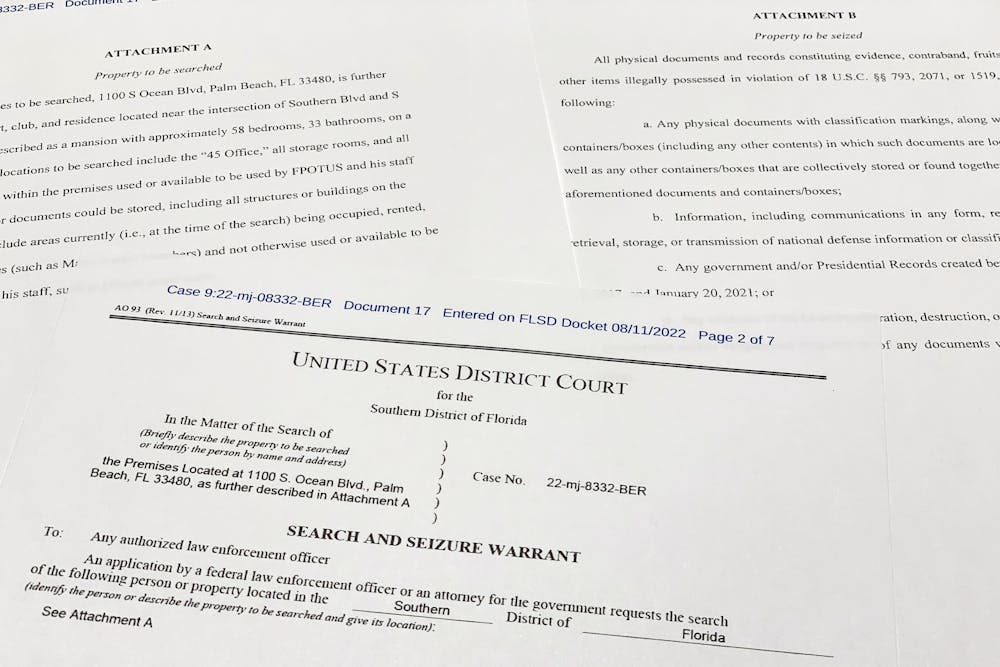
According to the search warrant, agents at Mar-a-Lago were seeking evidence of three potential violations of federal statutes: a section of the Espionage Act that makes it a crime to possess or share national defense secrets without authorization, a law against destroying or concealing documents to thwart an investigation, and a law against stealing, destroying or mutilating government records.

Government officials had worried as Trump left office that he presented what experts considered the perfect profile of a security risk: He was a disgruntled former employee, with access to sensitive government secrets, dead set on tearing down what he believed was a deep state out to get him. But Trump had spent years nurturing a growing distrust among his most fervent supporters of the agencies charged with monitoring those risks, the FBI and Justice Department.

What’s in the FBI’s unsealed Mar-a-Lago warrant

Justice Department officials have declined to comment on the documents probe or provide details about its findings, citing general privacy protocols for ongoing investigations. Trump spokesman Taylor Budowich did not address questions for this article but shared a statement attacking “this unprecedented and unnecessary raid,” blaming the Biden administration and accusing the media of “suggestive leaks, anonymous sources and no hard facts.”

Immediately after the search, Trump seemed to believe the FBI had played into his hands. Instead of exhibiting any concern, two people who spoke to him Monday evening both reported that Trump was “upbeat,” convinced the Justice Department had overreached and would cause Republicans to rally to his cause and help him regain the presidency in 2024.

“He feels it’s a political coup for him,” said one friend, who spoke to Trump repeatedly during the week. Like many others interviewed for this article, the person spoke on the condition of anonymity given the sensitivity of the criminal probe.

By Friday, however, the unsealed court records showed agents had seized 11 sets of classified documents, among other things. Republicans’ howls of protest became somewhat more muted, and people around Trump said his buoyant mood at times turned dark.

A simmering investigation

The fight over documents taken from the White House when Trump left office had been brewing for well over a year. “This has been like a pot of water that very slowly simmers, and now it’s making that noise where it hits the hot burner,” said a person involved with the dispute.

In the spring of 2021, the National Archives and Records Administration, the government agency charged by law with maintaining the papers of former presidents, alerted Trump’s team to a problem. In going through materials transferred from the White House in the chaotic final days of Trump’s presidency, officials had noticed that certain high-profile documents were missing. Trump’s correspondence with North Korean leader Kim Jong Un that he had termed “love letters.” A National Weather Service map of Hurricane Dorian, which Trump had famously marked up with a black Sharpie pen to extend to Alabama.

Under the Presidential Records Act, the items belonged to the American people. The Archives asked for them back.

People familiar with those initial conversations said Trump was hesitant to return the documents, dragging his feet for months as officials grew peeved and eventually threatened to alert Congress or the Justice Department to his reticence.

On Jan. 17 of this year, Trump relented, allowing a contractor for the Archives to load up 15 boxes at Mar-a-Lago and truck them north to a facility in Maryland. The boxes contained some of the notable items of the Trump presidency that Archives officials had sought.

15 boxes: Inside the long, strange trip of Trump’s classified records


But as Archives officials sifted through the recovered documents, they began to suspect some records were still missing. They also realized some of the returned material was clearly classified, including highly sensitive signals intelligence — intercepted electronic communications such as emails and phone calls of foreign leaders.

All of this raised a distressing possibility: Might there still be classified records tucked away at Trump’s private Florida club?

Although presidents have unrestricted power to declassify America’s secrets, they lose that power as soon as they leave office.

By February, Archives officials had formally referred the matter to the Justice Department.

The agency was already deeply engaged in one of the largest criminal investigations in the nation’s history: a sprawling exploration of the attack on the U.S. Capitol on Jan. 6, 2021, inspired by Trump’s rhetoric about his election loss.

Hundreds had been charged with storming the Capitol or helping to plan the insurrection. But Garland was under enormous pressure to also examine Trump’s role in fueling the riot, as well as the campaign by the former president and his advisers to overturn the certified results. Now the attorney general faced a new dilemma: what to do about the missing documents.

Before, During, After: A Washington Post investigation of the Jan. 6 attack

Garland — a former appeals court judge determined to avoid his predecessors’ missteps in politically fraught cases — refused to tip his hand over how the department might treat the 45th president.

“We follow the facts and the law wherever they lead. That’s all I can say,” he told reporters who asked about Trump at an April briefing about an unrelated matter. “It’s our long-standing norm to not comment on ongoing investigations. The best way to undermine investigations is to say things out of court about how they are going.”

In picking Garland, President Biden had insisted he was making a choice that would restore the department’s independence, a marked departure from the Trump administration, in which officials were largely expected to show fealty to the president — and publicly criticized when they didn’t.

“You won’t work for me,” Biden told his nominee. “You are not the President or the Vice President’s lawyers. Your loyalty is not to me. It’s to the law, the Constitution, the people of this nation to guarantee justice.”

Jamie Gorelick, a deputy attorney general under President Bill Clinton who brought Garland on as her chief aide and considers him a personal friend, said she was confident that he was not swayed by the public criticism.

“That would not motivate him one bit,” she said. “He is by the book. He would not take into account politics. He just wouldn’t.”

At first, Archives officials believed the FBI wasn’t taking the documents issue seriously and grew frustrated, according to people familiar with the document dispute.

But agents had interviewed Trump’s current and former advisers, asking them how the boxes taken to Mar-a-Lago were packed, what material was in them, who was responsible for the packing and what might still be at the Florida club, according to a person who was questioned.

“They interviewed almost everyone who worked for him,” a Trump adviser said.

Then, the Justice Department slapped Trump with a grand jury subpoena.

Bobb, a Trump lawyer, said Trump’s legal team embarked on a thorough review of all the presidential material still at Mar-a-Lago, including what she told The Washington Post were two dozen to three dozen boxes of documents held in a storage room on the first floor of the club, below areas open to the public. She told Fox News’s Laura Ingraham that the lawyers had identified all the documents they believed could be considered government property. “We turned over everything that we found,” she said.

But as discussions progressed, some law enforcement officials came to suspect Trump’s representatives were not being truthful at times — and that despite the months of conversations, Trump was still holding on to documents and other items that properly belonged with the Archives.

Guarding national secrets

A Trump adviser said the former president’s reluctance to relinquish the records stems from his belief that many items created during his term — photos, notes, even a model of Air Force One built to show off a new paint job he had commissioned — are now his personal property, despite a law dating to the 1970s that decreed otherwise.

“He gave them what he believed was theirs,” the adviser said.

“He gets his back up every time they asked him for something,” said another Trump adviser. “He didn’t give them the documents because he didn’t want to. He doesn’t like those people. He doesn’t trust those people.”

The Trump search warrant focuses on classified information. What you need to know.

John F. Kelly, Trump’s former chief of staff, said the former president had long exhibited a lack of respect for the strict rules for document handling sacred to the intelligence community, which is in the business of guarding the country’s national security.

“His sense was that the people who are in the intel business are incompetent, and he knew better,” Kelly said. “He didn’t believe in the classification system.”

Former national security adviser John Bolton said “almost nothing would surprise me about what’s in the documents at Mar-a-Lago.” He recalled that Trump would at times ask to keep the highly classified visual aids, pictures, charts and graphs prepared to augment his presidential daily brief, a document presented to him each day about key pressing issues, which he did not typically read.

“People were nervous enough about his lack of concern for classification matters that the briefers typically said, ‘Well, we need to take it back,’ ” Bolton said. “He’d usually give it back — but sometimes he wouldn’t give it back.”

John Bolton, national security adviser in the Trump administration, recalled that the president would at times ask to keep the highly classified visual aids, pictures, charts and graphs prepared to augment his presidential daily brief. (Jabin Botsford/The Washington Post)

Advisers said they also regularly saw Trump destroy documents, both in the White House and at Mar-a-Lago.

‘He never stopped ripping things up’: Inside Trump’s relentless document destruction habits

Though Trump has styled the Florida facility as a presidential home, and it is secured by the Secret Service, law enforcement knew that it was hardly the kind of hardened government installation suited to house secret documents.

In addition to Trump’s private quarters, the club includes a dining room, pool, tennis courts and spa, all accessible to its several hundred members during the winter months. A ballroom can be booked for weddings, galas and other events. The perils of securing the facility were been made clear in 2019, when a Chinese national, carrying phones and other electronic devices, was arrested after getting past a reception area by saying she was headed to the pool.

In early June, a small knot of federal investigators arrived at Mar-a-Lago to discuss the document issue with Trump’s lawyers. It was clear they believed their mission was serious — the team was headed by Jay Bratt, chief of counterintelligence and export control, the division of the Justice Department that leads investigations into leaks of government secrets.

Trump greeted the officials and offered a show of cooperation, said Bobb, who attended the meeting along with another lawyer for the former president, Evan Corcoran. “He pointed to the attorneys there and said, ‘anything they need, make sure they do it,’ ” she told Fox News.

Bobb told The Post that the group toured the storage facility, opening boxes and flipping through the records inside. She said Justice Department officials indicated they did not believe the storage unit was properly secured, so Trump officials added a lock to the facility.

Federal officials also obtained security camera footage of Mar-a-Lago around that time, according to people familiar with the situation.

Trump maintained that his lawyers had established a “very good” rapport with federal investigators. “They could have had whatever they wanted, if we had it,” he said in a statement Friday.

A judge signs off

On Sunday, the day before the search, Earl Steinberg went for an hour-long walk with Garland near their homes in suburban Maryland. The two men have been friends since early childhood, rooming together at Harvard University. Steinberg said he was best man at Garland’s wedding.

As they strolled, Garland “showed absolutely no hint that something stressful was about to happen. None. Zero,” Steinberg said. He added that “there is no way” the attorney general would have sought a search warrant “without having major concern about there being something dangerous” in the documents he believed might reside at Mar-a-Lago.

“He is somebody who weighs every potentially relevant consideration,” said Steinberg, who made clear he was speaking generally about Garland’s approach and never discussed the search warrant with him. “He would have considered public reaction, and the fact that this would be viewed as an extreme action that would have required an unassailable justification. That is, if anybody knew the facts he knew, they would have thought it appropriate to do what he did.”

Two days earlier, on Friday, a federal magistrate judge in West Palm Beach had approved the search warrant. That meant the judge had reviewed a sealed filing describing steps taken in the investigation so far and found there was probable cause that evidence of a crime would be located at the 17-acre club property.

When agents arrived Monday morning, Trump’s team scrambled to respond.

"Who’s in Florida?” Corcoran, one of the president’s lawyers, asked others, explaining that the FBI was currently at the former president’s house, a person familiar with the matter said. The team quickly dispatched Bobb, who lives in the Sunshine State and had assisted Rudy Giuliani in questioning the results of the 2020 election, then spent time as a host on the pro-Trump media outlet One America News.

When she arrived, Bobb said, she asked to be allowed to observe the agents, but was refused. Instead, she said, she stood on a driveway in the swampy heat for more than eight hours as the search proceeded.

The Secret Service declares the area restricted at the gates of the Palm Beach, Fla., home of former president Donald Trump on Aug. 8. (Eva Marie Uzcategui/Getty Images)

At 6:19 p.m., Bobb signed off on a three-page receipt describing the records that had been taken away: 11 sets of classified documents, several of them top secret; information about the president of France. At the top of the list was an executive grant of clemency for Roger Stone, a longtime Trump friend and political adviser who was convicted by a jury of seeking to impede a congressional investigation into Russian interference in the 2016 election.

People close to Trump said the search caught them all by surprise, at a time when Trump and his lawyers had been more focused on the New York probe of Trump Organization business practices and state and federal investigations of the efforts to reverse the 2020 election.

Trump and his team quickly began speculating that the FBI had been tipped by a disloyal insider, particularly given how many of his advisers have been interviewed by authorities about the document issue. “There were two days of crazy talk in Trump world about who was the mole, who was the informant,” one adviser said. “Fingers were pointed at all sorts of people.”

Bobb became the face of Trump’s legal pushback, booking time on Fox and other conservative media outlets. But behind the scenes, Trump’s allies initiated a hunt for new attorneys who might be more experienced with the complex battle with the Justice Department they knew was about to begin.

There was a growing realization, in the words of one close adviser, that the former president could be in for a “big fight for a long time.”

It was a familiar predicament for Trump, who has changed lawyers repeatedly since 2016 and has at times had trouble finding high-powered counsel to take up his cause.

Jon Sale, a prominent Florida defense attorney who had been part of the Watergate prosecutorial team, confirmed he was asked this week to represent Trump — and declined. He called the request a “privilege” but said that because of “other professional commitments,” he did not have the time to provide the kind of lawyering he believed Trump will need.

As the week progressed, Trump grew angrier, at times screaming profanities to advisers about the FBI and how they were out to “get him,” people who were in contact with him said.

Many Republicans echoed his outrage, accusing the Justice Department — without providing evidence — of infringing on the rights of a former president and targeting a possible 2024 rival to Biden.

Pleading the Fifth


On Wednesday, Trump sat for his deposition before New York Attorney General Letitia James (D), who is probing his pre-presidential business dealings. He cited the Mar-a-Lago search as he invoked his Fifth Amendment right against self-incrimination more than 400 times.

For years, Trump had mocked others who took the Fifth, arguing it was a sign of guilt. “If you’re innocent, why are you taking the Fifth Amendment?” he taunted his Democratic opponent, Hillary Clinton, in 2016. But now he leaned on the FBI’s actions in Florida to change his tune, insisting he was being targeted by prosecutors and therefore should keep his mouth shut.

In the face of Trump’s accusations, the Justice Department at first maintained its traditional silence.

But the temperature was rising on the right, with online message boards filled with Trump supporters pledging violence and even civil war over the FBI’s actions. On Thursday morning, a man in body armor was killed by police after trying unsuccessfully to breach an FBI field office in Cincinnati. He left behind a long trail of posts supporting Trump on the former president’s social media platform, Truth Social, including a “call to arms” issued shortly after Trump revealed the Mar-a-Lago raid.

“Be ready to kill the enemy,” he posted on Tuesday. “Kill [the FBI] on sight.”


With Trump’s lawyers already talking about the search warrant, and many Republicans attacking the FBI’s motives, Garland found a way to stick to Justice Department rules and still defend the FBI and prosecutors. Justice Department lawyers filed court papers seeking to unseal the Trump search warrant. And Garland issued a rare public statement saying he personally had approved the court-authorized search and denounced threats of violence to law enforcement.

In doing so, the often cautious former judge took a major step — staking his reputation on what will likely be the issue that defines his tenure as attorney general.

“Upholding the rule of law means applying the law evenly without fear or favor,” he said. “Under my watch, that is precisely what the Justice Department is doing.”

The White House told reporters they learned of Garland’s plan to speak not from the Justice Department, but from news reports.

When released on Friday, the search warrant underscored the seriousness of the FBI search. Agents wrote that they were seeking evidence of violations of three different statutes. A Washington Post report that the FBI was seeking documents related to nuclear weapons had also sent a ripple through Trump’s support network.

The former president kept up a steady stream of angry online statements, mixing outright denials with near-admissions that he had indeed been holding sensitive material about nuclear weapons.

“President Barack Hussein Obama kept 33 million pages of documents, much of them classified,” Trump said in a statement Friday that was quickly debunked by the National Archives, which said it controls all of Obama’s papers.

Trump went on to speculate baselessly: “How many of them pertained to nuclear?” he asked. "Word is, lots!”

Nowhere in the statement did he address whether he had done the same.

Today's Tweet


Aug 14, 2022

Meanwhile, In Smarmspace

Justin King - Beau Of The Fifth Column

Smarmspace: the distance between promise and delivery; between the spirit of the law and the letter of the law; where loopholes are found, and often manufactured; the land of rationalization. Trump is The King Of Smarmspace, and he's taught his devotees well.

Aug 13, 2022

Today's Beau

Justin King - Beau Of The Fifth Column

It's not about getting what I want - it's about making sure people I don't like can't get what they want.