Aug 28, 2022

About That America First Thing

It's pretty annoying that we have to keep explaining the point that certain phrases and the ideas they signify are shitty things that we've had to deal with more than a few times before.


The phrase “America First”
became a national slogan in 1915....
...Then it became a wartime jingoistic slogan on par,
as was noted at the time, with “Deutschland über Alles”...

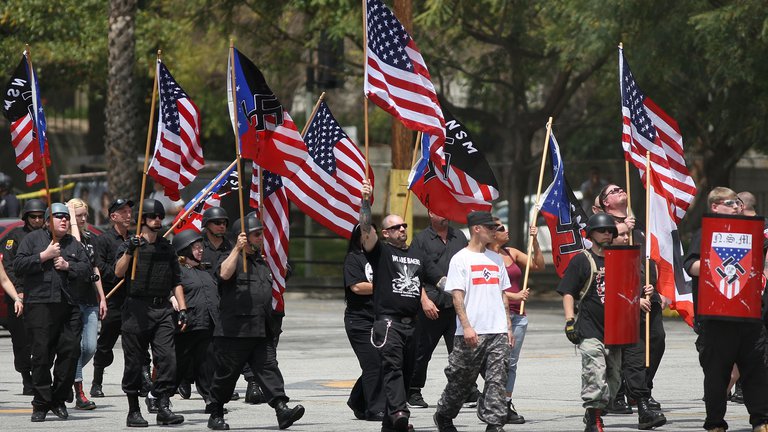
...At the same time, a new political group was organizing and asserting a national presence – the Ku Klux Klan. By the mid-1920s, the Klan had as many as five million members.
In other words, one out of every three or four white Protestant American man was a Klansman.

10-Minute Talks: America first and American fascism
by Professor Sarah Churchwell
06-20-2020
Hello, my name is Sarah Churchwell. I'm the Director of the Being Human Festival, the UK's national festival of the humanities, and Chair of Public Understanding of the Humanities at the University of London’s School of Advanced Study, where I research and write about American cultural history. For this special Summer Showcase 10-Minute Talk, I'm going to give a brief history of the slogan “America First” and its relation to lesser-known histories of American fascism.

When Donald Trump chose “America First” as one of his favourite political slogans – a phrase he went on to emphasise not only on the campaign trail but in his inaugural address and countless times during his presidency, many observers pointed to the troubling history behind the slogan.

What may seem at first glance merely a patriotic or nationalistic slogan – one that implies economic protectionism – in fact has a much longer and darker history in American political discourse than many people realise.

When Trump resurrected “America First” worried observers pointed to the most notorious iteration of the phrase – the America First Committee of 1942/1941, eventually led by Charles Lindbergh, whose anti-Semitic prejudices were well known at the time, and clearly demonstrated historically in the publication of his diaries and correspondence, where he privately mused about the so-called “Jewish problem” and the “Jewish question”, but also in public speeches he made, drawing on anti-Semitic tropes from the notorious forgery “The Protocols of the Elders of Zion”, which claimed that a Jewish conspiracy of bankers and media moguls was controlling the world. The same tropes that Hitler and Goebbels used in their own anti-Semitic propaganda.

The America First Committee, or AFC, sought to keep the United States out of World War II, on the basis that the fight against fascism was not America's fight. Some supported this position for motives of isolationism, others as pacifists or conscientious objectors, but a great many – like Lindbergh himself – also believed that what they called “Jewish interests” were trying to manipulate America into joining the war against its national interests. Implying, again as did the Nazis, that only Jewish people criticize Nazis and that Jewish interests were not only distinct from, but opposed to, America's national interest. The obvious implication being that Jewish-Americans are not really Americans at all. Lindbergh repeatedly said in his “America First” speeches that America should only join a European war if it was to protect what he called “the white races” from foreign invasion by “some Asiatic intruder”. That was reason to go to war in Europe, but fighting fascism for Lindbergh was not. As long as white people were in charge, he said, in so many words, it didn't matter if they were German fascists or British democrats. The AFC was denounced by many at the time as a force for appeasement; Lindbergh a Vichy figure – an American collaborator.

Part of the objection expressed by American anti-fascist voices at the time, however, was also to the long history of the phrase “America First” itself. This was not in fact a slogan that emerged with the Second World War, but rather with the First. American adults in 1940 had grown up with this phrase and they knew it was what we call a ‘dog whistle’ – a coded reference intended to be understood by a target audience, that might seem innocent to the unaware.

The phrase “America First” became a national slogan in 1915. President Woodrow Wilson used it to tell the country that what were known as “hyphenate Americans” at the time, which is to say immigrant communities – German-Americans, Irish-Americans, Italian-Americans – needed to identify their loyalty. Was it “America First”, he demanded, or was it not? In other words, the President of the United States used the phrase “America First” as a loyalty test for recently naturalised American citizens. The slogan immediately exploded into a national catchphrase. Both Wilson his Republican opponent used it in the 1916 election, then it became a wartime jingoistic slogan on par, as was noted at the time, with “Deutschland über Alles”.

After the war, “America First” was used by isolationists, including William Randolph Hearst, to keep America out of the Treaty of Versailles and League of Nations. Then Warren G Harding successfully campaigned in 1920 on an isolationist, protectionist, “America First” platform, before the phrase was used to pass anti-immigration, eugenicist, restrictionist legislation in the mid-1920s. At the same time, a new political group was organising and asserting a national presence – the Ku Klux Klan. By the mid-1920s, the Klan had as many as five million members. In other words, one out of every three or four white Protestant American man was a Klansman.

The first Klan had been established in 1866 by a bunch of disaffected white supremacists in the immediate aftermath of the Civil War, after the emancipation of slaves and the extension of the franchise to African-American men. The Klan was only the most famous of many white supremacist groups that committed atrocities after the Civil War across the American South including torture, mutilation, dismemberment and burning human beings alive. They murdered black politicians in public, in broad daylight to stop them asserting their new legal and political rights. Their behaviour was so vicious and so lawless that the federal government took action and brought the organisation down, so the Klan was defunct by the mid-1870s, but although the organisation was gone, its savage and malevolent beliefs and behaviours survived.

It was at this time that the white south began erecting Confederate monuments to leaders of the Klan and the Confederate Army that marched against the United States government to secure its right to hold other human beings in bondage. It was also at this time that the white south began to whitewash, in every sense, its motives and actions during the conflict, rewriting history to say that slavery and white supremacism had not motivated the war but rather the incursion of federal government into state’s rights. The specific states right that they had fought over was in fact their right to keep slaves, but they began to skip that part and then to deny it outright.

In 1915, the same year that President Wilson who was born in the slaveholding south, before the Civil War and an avowed segregationist made “America First” a catchphrase, a Jewish man named Leo Frank was lynched in Atlanta a few months after a film called The Birth of a Nation was released. The film glorified the first Klan as a noble uprising of white people protecting their way of life from vicious marauding black people, when in historical fact it was exactly the other way around. The two events together sparked the rebirth of the Klan.
The second Klan declared itself a 100% American organisation that believed in Christian nationalism and ‘upheld white supremacism’. That is their language. One of its favourite slogans was ‘America First’ which is printed on pamphlets and ads announcing its explicit commitment to white supremacism.

At exactly the same time, in the early 1920s a new political phenomenon arose in Italy called fascism, as Mussolini took power. Americans instantly recognised what they were watching, as just a few quotations from American newspapers in 1921 and 1922 – as Mussolini took power – attest. The “Fascisti'”, they said, “might be known as the Ku Klux Klan” or “the Klan is the Fascisti of America” or “the single success of the Fascisti, or Italian Ku Klux Klan” or “the Fascisti is a secret order having some of the Ku Klux Klan method” and so on.

By the end of the 1920s, the second Klan was in decline – brought down by corruption and sex scandals – plus ça change! But in its stead soon sprouted a host of nativist, Christian nationalist, conspiratorial, anti-Semitic, white supremacist and xenophobic groups that borrowed many of the impulses and symbolisms of European fascism, including coloured shirts. In America in the 1930s there were the Blackshirts, the Khaki Shirts, Silver Shirts, White Shirts, the Brownshirts of Father Coughlin, the Greyshirts and the Dress Shirts – among many other extreme right-wing groups. The German American Bund began its existence as the “Friends of Hitler” movement before holding rallies and parades that matched the American stars and stripes with swastikas. All of these groups professed themselves “100% American”, and said they “put America first”. By the late 1930s they were referred to collectively and pejoratively in interchangeable terms as “Bundists”, “100 Percenters” and “America Firsters”. When the America First Committee formed in 1940 and began to urge America to stay out of the war, it was drawing on this long rhetorical history that everyone knew, and all of these groups flocked to it, seeing in it the political legitimacy they had long sought. Not everyone in the AFC agreed with the positions of what was called the lunatic fringe at the time, but they singularly failed to separate themselves from it – to denounce these supporters.

Ten minutes is not enough time to explain this complex, dark, controversial and inflammatory history. I have left an enormous amount out of this story, including how much European fascist movements learned from the structures and arguments of American white supremacism and anti-Semitism. But even the bare bones I presented in these brief minutes should help us hear the ferocious irony in the title of Sinclair Lewis’ best-selling 1935 novel, It Can’t Happen Here.

Aug 27, 2022

Today's Pix

click
👇🏻


Today's Church & State


Contrary to popular memes, Amy Coney Barrett is not a Handmaid. She's a full-blown god-knobbin' zombie zealot.


Revealed: leaked video shows Amy Coney Barrett’s secretive faith group drove women to tears

Wife of founder of People of Praise says members ‘were always crying’ during discussions about women’s subservience to men


The People of Praise, a secretive Christian faith group that counts the conservative supreme court justice Amy Coney Barrett as a member, considered women’s obedience and subservience to men as one of its central early teachings, according to leaked remarks and writings of the wife of one of the group’s founders.

A leaked video of a recent private People of Praise event, marking its 50th anniversary, shows Dorothy Ranaghan explaining how some female followers of the faith group cried intensely in reaction to the group’s early teachings on “headship” and the “roles of men and women”, in which men are considered divinely ordained as the “head” of the family and dominant to women.

Asked in an interview during the anniversary event about the years after the group’s members first made a “covenant” to join People of Praise in the early 1970s, Dorothy Ranaghan said: “Some of the women – who are still in my women’s group, as a matter of fact – were wearing sunglasses all the time, because they were always crying and would have to hold on to their chairs every time somebody started teaching, because ‘What are we going to hear this time?’”

She then added, as the audience and her interviewer laughed: “But it all worked out just fine in the end.”

The comment marks the first time a statement about some women’s negative early responses to “headship” teachings has been published. The leaked footage was shared with the Guardian by a source who asked to remain anonymous.

Former members of People of Praise, many of whom are critical of the group’s dominance over members’ lives, have described the group as calling for complete obedience of women to their husbands.

The Guardian has previously reported that one of the group’s former members described in a sworn affidavit filed in the 1990s that Kevin Ranaghan – a group co-founder and Dorothy’s husband – exerted almost total control over the former member when she was living in the couple’s household, including making all decisions about her finances and dating relationships. The group also embraces traditions like encouraging members to speak in tongues, and performing exorcisms.

"Women in my group were always crying"

Barrett, who lived in the Ranaghan household while she attended law school at Notre Dame, has never publicly disclosed or discussed her membership in the Christian charismatic sect, where her father had a leadership role and where she previously served as a “handmaid”. Barrett has said she is a “faithful Catholic” whose religious beliefs would not “bear in the discharge of my duties as a judge”.

But while Barrett’s personal faith-based opposition to abortion rights and Roe v Wade were known before her 2020 confirmation and before she joined a majority of justices in overturning the landmark ruling that protected abortion rights nationally, less is known about the culture in which Barrett was raised and its views on women and childbirth, suffering, and their role in society.

Barrett has never addressed how the reversal of Roe might affect a woman’s life. But during oral argument in Dobbs v Jackson, the supreme court case that ultimately overturned Roe, Barrett referred specifically in questions to the availability of so-called “safe haven” laws across the US, which allow mothers to abandon newborns in designated locations without the risk of punishment.

Barrett suggested that the availability of such legal protections for new mothers meant that while women might be forced to give birth if Roe were overturned, they would not necessarily be forced to become parents, or be burdened by parenthood.

The line of reasoning was decried as “cruel and dangerous” by pro-choice activists and writers, who said that seeing safe haven laws as a viable replacement for reproductive choice ignored real health risks associated with pregnancy and childbirth, and ignored women’s rights to bodily autonomy.

Barrett’s question also appears to echo the People of Praise culture in which she was raised and has chosen to remain a part of, which emphasizes the importance of childbirth, pregnancy and the abandonment of autonomy and privacy it supposedly entails, as a core part of what it means to be a woman.

In her early writings, Dorothy Ranaghan emphasized the need for women to be “self-giving, responsible and reserved”. In a 1978 article that appeared in New Covenant magazine, called “Fully a Woman”, childbearing is described as a “central reality of womanhood” that “determines our presence in the world”, even for those who “by chance or choice” did not have children.

“The child in the womb expands the mother’s body, changing its dimensions. As her body yields, so do the borders of privacy and selfishness. Her very existence gives to another.” Women who are most admired, she wrote, “are not private persons, but are surrendered and available to care for others”.

“Pregnancy teaches a woman that others have a claim on her very person for the service of life. Rather than annihilating her, pregnancy makes her a new person, radiant and strong: a mother,” she wrote.

Once women gave birth in the People of Praise, work to care for them is divided on gender lines, according to Adrian Reimers, a Catholic theological critic and early member of the People of Praise who was dismissed in 1985 and wrote about his experience.

Reimers’ book critiquing the group, called Not Reliable Guides, states that men in People of Praise “were quietly taught by their heads and leaders not to change or rinse out diapers” and that women’s emotions were “distrusted”. Pastoral problems were often addressed by asking a woman where she was in her menstrual cycle.

Women, Reimers wrote, played a “decidedly secondary role to men” and a married woman was “expected always to reflect the fact that she is under her husband’s authority” and under his pastoral care. A guide on the group’s approach to outreach in the Caribbean, Reimers said, explicitly stated: “We should probably deal with the Caribbean matriarchal system by quietly developing an alternate rather than encouraging a confrontation.”

Reimers has written that he believed that the People of Praise’s views on women were rooted not in the Catholic tradition, but rather in Kevin Ranaghan’s involvement in the 1970s National Men’s Shepherds Conference, which was co-sponsored by Protestant leaders and believed that men were ordained by God to lead.

“It is no surprise that all these communities see feminism as one of the principle [sic] ideological evils of our time,” Reimers wrote.

In a statement released after publication of this article, Dorothy Ranaghan said: “My remarks were meant as a joke as most of the people in the room understood. I would never be part of a group that oppresses women and I never have been part of one. But I have been proud to be one of the women leaders in the People of Praise for more than 50 years.”

She added: “I’ve been in the company of many strong women – lawyers, doctors, educators, businesswomen, wives and mothers, and we are in no way oppressed or dominated. We are responsible for our own decisions; we are free and happy. Furthermore, it is unconscionable to me that any of the more than 40 men and women who have lived with our family over the years would consider my husband an oppressor. As those who know him would agree, he is a kind, gentle man who listens carefully and respects the opinions of women and men and he always has.”

Barrett did not respond to a request for comment.

He's A Bad Man


(pay wall)

Donald Trump Is Not Above the Law

Over the course of this summer, the nation has been transfixed by the House select committee’s hearings on the events of Jan. 6, 2021, and how or whether Donald Trump might face accountability for what happened that day. The Justice Department remained largely silent about its investigations of the former president until this month, when the F.B.I. searched his home in Palm Beach, Fla., in a case related to his handling of classified documents. The spectacle of a former president facing criminal investigation raises profound questions about American democracy, and these questions demand answers.

Mr. Trump’s unprecedented assault on the integrity of American democracy requires a criminal investigation.
The disturbing details of his post-election misfeasance, meticulously assembled by the Jan. 6 committee, leave little doubt that Mr. Trump sought to subvert the Constitution and overturn the will of the American people. The president, defeated at the polls in 2020, tried to enlist federal law enforcement authorities, state officials and administrators of the nation’s electoral system in a furious effort to remain in power. When all else failed, he roused an armed mob that stormed the Capitol and threatened lawmakers.

The Justice Department is reportedly examining Mr. Trump’s conduct, including his role in trying to overturn the election and in taking home classified documents. If Attorney General Merrick Garland and his staff conclude that there is sufficient evidence to establish Mr. Trump’s guilt on a serious charge in a court of law, then they must seek an indictment too.

This board is aware that in deciding how Mr. Trump should be held accountable under the law it is necessary to consider not just whether criminal prosecution would be warranted but whether it would be wise. No American president has ever been criminally prosecuted after leaving office. When President Gerald Ford pardoned Richard Nixon, he ensured that Nixon would not be prosecuted for crimes committed during the Watergate scandal; Ford explained this decision with the warning that such a prosecution posed grave risks of rousing “ugly passions” and worsening political polarization.

That warning is just as salient today. Pursuing prosecution of Mr. Trump could further entrench support for him and play into the conspiracy theories he has sought to stoke. It could inflame the bitter partisan divide, even to the point of civil unrest. A trial, if it is viewed as illegitimate, could also further undermine confidence in the rule of law, whatever the eventual outcome.

The risks of political escalation are obvious. The Democratic and Republican parties are already in the thick of a cycle of retribution that could last generations. There is a substantial risk that, if the Justice Department does prosecute Mr. Trump, future presidents — whether Mr. Trump himself or someone of his ilk — could misuse the precedent to punish political rivals. If their party takes a majority in the House of Representatives after the midterm elections, some Republicans have already threatened to impeach President Biden.

There is an even more immediate threat of further violence, and it is a possibility that Americans should, sadly, be prepared for. In the hours after federal agents began a court-approved search of Mr. Trump’s residence in Palm Beach, based on a warrant investigating possible violations of three federal laws, including one that governs the handling of defense information under the Espionage Act, his most fervent supporters escalated their rhetoric to the language of warfare. As The Times noted, “The aggressive, widespread response was arguably the clearest outburst of violent public rhetoric since the days leading up to the Jan. 6 attack on the Capitol.”

Mr. Garland has been deliberate, methodical and scrupulous in his leadership of the Justice Department’s investigations of the Jan. 6 attack and the transfer of documents to Mr. Trump’s home. On Friday a redacted version of the affidavit used to obtain the warrant was released, revealing that the Justice Department asked to search the premises to recover documents because of concerns that their disclosure could compromise “clandestine human sources” of intelligence and because it had
probable cause to believe it would find “evidence of obstruction” at the premises.

No matter how careful Mr. Garland is or how measured the prosecution might be, there is a real and significant risk from those who believe that any criticism of Mr. Trump justifies an extreme response.

Yet it is a far greater risk to do nothing when action is called for. Aside from letting Mr. Trump escape punishment, doing nothing to hold him accountable for his actions in the months leading up to Jan. 6 could set an irresistible precedent for future presidents. Why not attempt to stay in power by any means necessary or use the power of the office to enrich oneself or punish one’s enemies, knowing that the law does not apply to presidents in or out of office?

More important, democratic government is an ideal that must constantly be made real. America is not sustained by a set of principles; it is sustained by resolute action to defend those principles.

Immediately after the Jan. 6 insurrection, cabinet members reportedly debated privately whether to remove Mr. Trump from power under the authority of the 25th Amendment. A week after the attack, the House impeached Mr. Trump for the second time. This editorial board supported his impeachment and removal from office; we also suggested that the former president and lawmakers who participated in the Jan. 6 plot could be permanently barred from holding office under a provision of the 14th Amendment that applies to any official who has “engaged in insurrection or rebellion” or given “aid or comfort” to those who have done so. But most Republicans in the Senate refused to convict Mr. Trump, and Congress has yet to invoke that section of the 14th Amendment against him. As a result, the threat that Mr. Trump and his most ardent supporters pose to American democracy has metastasized.

Even now, the former president continues to spread lies about the 2020 election and denounce his vice president, Mike Pence, for not breaking the law on his behalf. Meanwhile, dozens of people who believe Mr. Trump’s lies are running for state and national elected office. Many have already won, some of them elevated to positions that give them control over how elections are conducted. In June the Republican Party in Texas approved measures in its platform declaring that Mr. Biden’s election was illegitimate. And Mr. Trump appears prepared to start a bid for a second term as president.

Mr. Trump’s actions as a public official, like no others since the Civil War, attacked the heart of our system of government. He used the power of his office to subvert the rule of law. If we hesitate to call those actions and their perpetrator criminal, then we are saying he is above the law and giving license to future presidents to do whatever they want.

In addition to a federal investigation by the Justice Department, Mr. Trump is facing a swirl of civil and criminal liability in several other cases: a lawsuit by the attorney general for the District of Columbia over payments during his inauguration ceremonies; a criminal investigation in Westchester County, N.Y., over taxes on one of his golf courses; a criminal case in Fulton County, Ga., over interference in the 2020 election; a criminal case by the Manhattan district attorney over the valuation of Mr. Trump’s properties; and a civil inquiry by New York’s attorney general into Mr. Trump and the Trump Organization.

The specific crimes the Justice Department could consider would likely involve Mr. Trump’s fraudulent efforts to get election officials in Georgia, Arizona and elsewhere to declare him the winner even though he lost their states; to get Mr. Pence, at the Jan. 6 congressional certification of the election, to throw out slates of electors from states he lost and replace them with electors loyal to Mr. Trump; and to enlist officials from the Departments of Justice, Homeland Security and Defense to persuade officials in certain states to swing the election to him and ultimately stir up a mob that attacked the Capitol. The government could also charge Mr. Trump with seditious conspiracy, a serious charge that federal prosecutors have already brought against leaders of far-right militia groups who participated in the Capitol invasion.

The committee hearings make it clear: Mr. Trump must have known he was at the center of a frantic, sprawling and knowingly fraudulent effort that led directly to the Capitol siege. For hours, Mr. Trump refused to call off the mob.


The testimony from hundreds of witnesses, many of them high-ranking Republican officials from his own administration, reveals Mr. Trump’s unrelenting efforts, beginning months before Election Day and continuing through Jan. 6, to sow doubt about the election, to refuse to accept the result of that election and then to pursue what he must have known were illegal and unconstitutional means to overturn it. Many participants sought pre-emptive pardons for their conduct — an indication they knew they were violating the law.

Other evidence points to other crimes, like obstruction of Congress, defined as a corrupt obstruction of the “proper administration of the law.” The fake-elector scheme that Mr. Trump and his associates pushed before Jan. 6 appears to meet this definition. That may explain why at least three of Mr. Trump’s campaign lawyers were unwilling to participate in the plot. People involved in it were told it was not “legally sound” by White House lawyers, but they moved forward with it anyway.

Cassidy Hutchinson, a top aide to Mr. Trump’s last chief of staff, Mark Meadows, provided powerful evidence that could be used to charge Mr. Trump with seditious conspiracy. In her public testimony at a Jan. 6 committee hearing, she said that Mr. Trump was informed that many in the throng of supporters waiting to hear him speak on the Ellipse that day were armed but that he demanded they be allowed to skip the metal detectors that had been installed for his security. “They’re not here to hurt me,” he said, according to Ms. Hutchinson. “Let my people in. They can march to the Capitol from here.”

If Mr. Garland decides to pursue prosecution, a message that the Justice Department must send early and often is that even if Mr. Trump genuinely believed, as he claimed, that the election had been marred by fraud, his schemes to interfere in the certification of the vote would still be crimes. And even though Mr. Trump’s efforts failed, these efforts would still be crimes. More than 850 other Americans have already been charged with crimes for their roles in the Capitol attack. Well-meaning intentions did not shield them from the consequences of their actions. It would be unjust if Mr. Trump, the man who inspired them, faced no consequences.

No one should revel in the prospect of this or any former president facing criminal prosecution. Mr. Trump’s actions have brought shame on one of the world’s oldest democracies and destabilized its future. Even justice before the law will not erase that stain. Nor will prosecuting Mr. Trump fix the structural problems that led to the greatest crisis in American democracy since the Civil War. But it is a necessary first step toward doing so.

The Dog That Caught The Car


The "straight-thinkers" in the GOP really didn't want Roe to be overturned. I'm one of those "liberals" who was sure that because the party was just playing the rubes, they'd always pull back just as it looked like the All-American Woman-Haters Club was about to make 'em do it.

And I think it's no kinda news that McConnell and McCarthy had that in mind too, but the crazies got their hands on the levers - which is what we've been warning about for 30 years - and they made it happen, and now what's left of the old guard is in that Wile E Coyote moment when they realize there's nothing under them but a very long fall to a very hard landing.


Couldn't happen to a nicer buncha guys.

 
(pay wall)

Buyer’s remorse could be creeping in for GOP on abortion

The signs are disparate, inconclusive and perhaps not fully applicable to the 2022 midterm elections. But virtually everything since the Supreme Court overturned Roe v. Wade back in June suggests Republicans have a political problem on their hands now that they’ve obtained their long-sought goal of being able to severely restrict and even ban abortion.

And if you look closely, you’ll see signs of potential buyer’s remorse creeping in.

To the extent Republicans rethink their extremely restrictive posture on abortion in the days ahead, a South Carolina state legislator might have provided a crystallizing moment last week.

At a hearing, state Rep. Neal Collins (R) recounted the arduous journey faced by a 19-year-old thanks to an abortion ban he himself supported. Collins said the woman’s fetus was not viable, but that attorneys told her doctor they couldn’t extract it because it still had a heartbeat — the standard set in the bill supported by Collins that had gone into effect just the week before.

“They discharged that 19-year-old,” Collins said. “The doctor told me at that point there is a 50 percent chance — well, first she’s going to pass this fetus in the toilet. She’s going to have to deal with that on her own. There’s a 50 percent chance — greater than 50 percent chance that she’s going to lose her uterus. There’s a 10 percent chance that she will develop sepsis and herself, die.”

Collins added: “That weighs on me. I voted for that bill. These are affecting people.”

It’s a dilemma previewed long before the Supreme Court’s momentous decision, including in this space. In many states, Republicans passed restrictive laws and what’s known as “trigger laws” that would ban almost all abortions, including in cases of rape and incest, and with stringent rules for exceptions to protect the mother’s health. Those measures worked well as messaging exercises, but now they will be law. And polls show those ideas are broadly unpopular.

Since the Supreme Court’s action, the evidence has pointed almost exclusively in one direction: that Democrats have been buoyed by the abortion issue taking on new prominence.
The conservative Wall Street Journal’s editorial board summarized it in a piece after the New York special election, titled “The GOP’s Abortion Problem.”

“Republicans are on the backfoot because they’re talking about abortion as if Roe were still the law, when it was easy to favor a total ban because it didn’t matter,” it wrote. “Now the policy stakes are real, and Republicans will have to make clear what specific abortion limits they favor and why.”

Republicans have been slow to do that. But there are signs that they recognize the peril of this issue’s sudden salience, and they’re charting divergent courses when forced to take positions.

In the New York special election, for instance, Republican Marc Molinaro said he opposed a federal abortion ban. Some GOP Senate candidates, particularly in the West, have effectively endorsed allowing abortion early in a pregnancy. Colorado Senate candidate Joe O’Dea has said abortion should be banned only after 20 weeks. Nevada Senate candidate Adam Laxalt endorsed banning abortion after 13 weeks. Arizona candidate Blake Masters called his state banning abortion after 15 weeks “a reasonable solution” after previously calling abortion “demonic” and likening it to genocide.

Efforts to reckon with rape, incest and other exceptions are less evident but are lurching forward in some red states. Arkansas Gov. Asa Hutchinson (R) has said he prefers the state to have them, but he has yet to press the issue with the state legislature. West Virginia’s state legislature added the exceptions after Democrats forced a vote on an amendment, though the final version of the bill remains uncertain. And Indiana Republicans split over an effort to nix rape and incest exceptions from their bill, leaving them in.

It’s too simple to say Democrats’ sudden signs of hope in their effort to keep Congress are exclusively the result of the abortion issue. It’s also possible this issue creates a Democratic turnout edge in primary and special elections that won’t be replicated in the general election, when more casual voters are more likely to vote.

What’s pretty clear, though, is that Republicans are in the kind of pickle the Wall Street Journal editorial board noted. They’ve now got this power to do something they’ve long said they aspired to do — and which their base demands — but which creates potential problems for them and their very real ambitions of reclaiming power in Washington. In many cases, as the video of state Rep. Collins shows better than just about anything, they’re now contending with the consequences.

At the very least, it’s a complicating factor. Now they must decide how much they fear that factor, and whether they can do anything about it without alienating the voters they’ve spent decades firing up about what was then a much more abstract — and apparently advantageous — issue.

Today's Trae

Trae Crowder - Liberal Redneck

College kids make some poor decisions - that's pretty much what being a college kid is all about.

Aug 26, 2022

On Slavery & War

(888) 373-7888
National
Human Trafficking Hotline


The Conversation

Slavery and war are tightly connected – but we had no idea just how much until we crunched the data

Some 40 million people are enslaved around the world today, though estimates vary. Modern slavery takes many different forms, including child soldiers, sex trafficking and forced labor, and no country is immune. From cases of family controlled sex trafficking in the United States to the enslavement of fishermen in Southeast Asia’s seafood industry and forced labor in the global electronics supply chain, enslavement knows no bounds.

As scholars of modern slavery, we seek to understand how and why human beings are still bought, owned and sold in the 21st century, in hopes of shaping policies to eradicate these crimes.

Many of the answers trace back to causes like poverty, corruption and inequality. But they also stem from something less discussed: war.

In 2016, the United Nations Security Council named modern slavery a serious concern in areas affected by armed conflict. But researchers still know little about the specifics of how slavery and war are intertwined.

We recently published research analyzing data on armed conflicts around the world to better understand this relationship.

What we found was staggering: The vast majority of armed conflict between 1989 and 2016 used some kind of slavery.

Coding conflict

We used data from an established database about war, the Uppsala Conflict Data Program (UCDP), to look at how much, and in what ways, armed conflict intersects with different forms of contemporary slavery.

Our project was inspired by two leading scholars of sexual violence, Dara Kay Cohen and Ragnhild Nordås. These political scientists used that database to produce their own pioneering database about how rape is used as a weapon of war.

The Uppsala database breaks each conflict into two sides. Side A represents a nation state, and Side B is typically one or more nonstate actors, such as rebel groups or insurgents.

Using that data, our research team examined instances of different forms of slavery, including sex trafficking and forced marriage, child soldiers, forced labor and general human trafficking. This analysis included information from 171 different armed conflicts. Because the use of slavery changes over time, we broke multiyear conflicts into separate “conflict-years” to study them one year at a time, for a total of 1,113 separate cases.

Coding each case to determine what forms of slavery were used, if any, was a challenge. We compared information from a variety of sources, including human rights organizations like Amnesty International and Human Rights Watch, scholarly accounts, journalists’ reporting and documents from governmental and intergovernmental organizations.

Alarming numbers

In our recently published analysis, we found that contemporary slavery is a regular feature of armed conflict. Among the 1,113 cases we analyzed, 87% contained child soldiers – meaning fighters age 15 and younger – 34% included sexual exploitation and forced marriage, about 24% included forced labor and almost 17% included human trafficking.


A global heat map of the frequency of these armed conflicts over time paints a sobering picture. Most conflicts involving enslavement take place in low-income countries, often referred to as the Global South.

About 12% of the conflicts involving some form of enslavement took place in India, where there are several conflicts between the government and nonstate actors. Teen militants are involved in conflicts such as the insurgency in Kashmir and the separatist movement in Assam. About 8% of cases took place in Myanmar, 5% in Ethiopia, 5% in the Philippines and about 3% in Afghanistan, Sudan, Turkey, Colombia, Pakistan, Uganda, Algeria and Iraq.

This evidence of enslavement predominately in the Global South may not be surprising, given how poverty and inequality can fuel instability and conflict. However, it helps us reflect upon how these countries’ historic, economic and geopolitical relationships to the Global North also fuel pressure and violence, a theme we hope slavery researchers can study in the future.

Strategic enslavement


Typically, when armed conflict involves slavery, it’s being used for tactical aims: building weapons, for example, or constructing roads and other infrastructure projects to fight a war. But sometimes, slavery is used strategically, as part of an overarching strategy. In the Holocaust, the Nazis used “strategic slavery” in what they called “extermination through labor.” Today, as in the past, strategic slavery is normally part of a larger strategy of genocide.

We found that “strategic enslavement” took place in about 17% of cases. In other words, enslavement was one of the primary objectives of about 17% of the conflicts we examined, and often served the goal of genocide. One example is the Islamic State’s enslavement of the Yazidi minority in the 2014 massacre in Sinjar, Iraq. In addition to killing Yazidis, the Islamic State sought to enslave and impregnate women for systematic ethnic cleansing, attempting to eliminate the ethnic identity of the Yazidi through forced rape.

The connections between slavery and conflict are vicious but still not well understood. Our next steps include coding historic cases of slavery and conflict going back to World War II, such as how Nazi Germany used forced labor and how Imperial Japan’s military used sexual enslavement. We have published a new data set,
Contemporary Slavery in Armed Conflict,” and hope other researchers will also use it to help better understand and prevent future violence.

New Day, New Shit


Takeaways from the redacted affidavit used for the Mar-a-Lago search

The largest piece of the puzzle about why FBI agents searched former president Donald Trump’s residence is out: the affidavit submitted to warrant the search. In its full form, this usually sealed document spells out exactly what FBI agents thought was hidden at Mar-a-Lago and what crimes may have been committed. But the version the Justice Department released to the public Friday is heavily redacted.

Here’s what we were able to glean about the investigation — and still have to learn.

1. 184 classified documents, including some top secret, were once at Mar-a-Lago

This affidavit, by definition, was written before FBI agents searched Trump’s clubhouse and took away more boxes of suspected classified information. They are likely sifting through that now. But when National Archives retrieved 15 boxes of official material in January from Mar-a-Lago, they found “a lot of classified records,” according to the affidavit, and flagged the FBI.

A subsequent FBI tally of classified information in those boxes found, according to the affidavit: “184 unique documents bearing classification markings, including 67 documents marked as CONFIDENTIAL, 92 documents marked as SECRET, and 25 documents marked as TOP SECRET.”

That’s an astonishing amount of classified material, legal experts said.

In addition, the FBI believed that the material contained what it calls “national defense information,” or some of the most guarded secrets. (The Washington Post has reported the government feared nuclear secrets were at Mar-a-Lago.)

In addition, the FBI was concerned that the classified information was treated carelessly. The National Archives wrote to the bureau that the boxes it retrieved from Mar-a-Lago contained: “newspapers, magazines, printed news articles, photos, miscellaneous print-outs, notes, presidential correspondence, personal and postpresidential records, and ‘a lot of classified records.’ Of most significant concern was that highly classified records were unfoldered, intermixed with other records, and otherwise unproperly [sic] identified.”

People who have worked at the White House and handled classified documents stress that each document is treated with extreme care; some of the most secret material are returned to a secure room or even a safe after the president or other authorized top officials review it.

“The affidavit confirms that the documents were stored in various locations around Mar-a-Lago and that none of these locations was an approved storage facility for classified material,” said Barbara McQuade, a former federal prosecutor.

2. The Justice Department is suspicious of obstruction by Trump or his allies

“There is also probable cause to believe that evidence of obstruction will be found at the PREMISES,” reads the affidavit. We don’t learn much more than that from this document.

But the affidavit states that the National Archives spent six months in the latter half of 2021 trying to get more documents. And then the FBI got involved. The Post’s Josh Dawsey, Carol Leonnig, Jacqueline Alemany and Rosalind Helderman reported that all this year, Trump resisted handing much of anything over, to the point where his allies feared he was “essentially daring” the FBI to come after them.

Trump was also warned before he even left the White House that taking any official documents with him, let alone national secrets, was illegal under the Presidential Records Act. And even Trump’s attorneys agreed that the former president needed to give the documents back, report Dawsey and Alemany, citing the National Archives’ conversations with Trump’s lawyers.

The Justice Department already released the search warrant that Judge Bruce E. Reinhart signed off on. It was a short document that revealed that the FBI found top-secret information there while looking for evidence of the violation of three potential crimes, including part of the Espionage Act. The affidavit doesn’t shed much more light on that.

3. It’s possible Trump allies were talking to the FBI about all this

Included in the paperwork with the affidavit was a formal notice that the redacted memorandum was being released. In it, the Justice Department writes that the redactions are necessary to protect “a broad range of civilian witnesses.”

“This language suggests that people inside Trump’s former administration, or at Mar-a-Lago, are providing information to the FBI,” McQuade said.

The redacted affidavit itself suggests that the investigation includes detailed monitoring of Mar-a-Lago to find out how many boxes of official material were still there and where they were being stored.

4. What’s missing


We’re not seeing the full affidavit; far from it.

The Justice Department was allowed to pretty liberally ink-out many details of its investigation, because lawyers said this was still in its early stages.

We don’t know exactly what they cut.

But Jack Sharman, a corporate litigator who has been involved in numerous government investigations, said affidavits that get publicly released are usually protective of confidential informants as well as personal identifying information of the informants, or of law enforcement agents, given the threats to law enforcement from some Trump supporters. (The name of the FBI agent primarily responsible for writing the affidavit is withheld.) Also, statements made by witnesses or informants can be redacted. And just about anything having to do with a related investigation or potential subjects or targets is usually cut from these kinds of releases, Sharman said.

5. We still don’t know why Trump wanted these documents

In addition to whether the Justice Department will charge Trump or someone in his orbit with a crime, why all these documents were at Mar-a-Lago in the first place is one of the biggest unanswered questions of this whole thing.

Trump and his lawyers were repeatedly asked to return them. Under requests from the National Archives, a subpoena and visits to Mar-a-Lago from Justice Department officials, they did return some boxes. But much more, it seems, remained in Trump’s possession.

6. The full affidavit is a road map to potential prosecution

An affidavit is essentially a report of all the evidence and witnesses and reasoning for why agents need a search warrant to go through someone’s private stuff. The private home of a former president has a particularly high bar, so this affidavit was likely extremely thorough and detailed.

Attorney General Merrick Garland signed off on it, and FBI agents presented this sworn document to a magistrate judge. The judge agreed that agents convincingly laid out there was probable cause that a crime was committed at Mar-a-Lago by Trump keeping classified documents there, or at least that there was strong potential of evidence of a crime. The search warrant and affidavit mention potential crimes that don’t require information to be classified, though. So simply just taking the material out of the White House and refusing to give it back could be enough for prosecution.

These affidavits are usually kept sealed, because they are a road map for any potential prosecution after the search. But citing the overwhelming public interest, Reinhart ordered the Justice Department to release as much as it could without revealing secrets of its ongoing investigation.

“It’s highly unusual that this is even happening, period,” Sharman said.

Thanks, Joe


On my travels across the intertoobz