Aug 4, 2022

Oops

This is one big fuckin' oops.

I should stop for a minute and think about how this could be the thread that binds it all together.

It's easy to look individually at
  • 800 boneheads who've already been sent to prison
  • The Proud Boys and The Oath Keepers
  • A dozen or so congress critters
  • About 20 White House staffers
  • 8 or 10 campaign aides
  • half a dozen cabinet officers
  • A few Pentagon guys
  • etc etc etc
- and come to what seems like a slam dunk conclusion about guilt and conspiracy to pull some batshit crazy inside coup.

But this being America - even USAmerica Inc - we have process. We have a set of rules we have to follow if we're going to stay true to our vision of Mom, and home-made apple pie, and baseball and Chevrolet, and all that other shit they try to sell us.

The big glitch has been trying to find something that could string it all together. Something that gathers all the players and rat-fuckers into one big maggot pile.


It's possible Alex Jones has just done a lot of that work for us.

News Times - Danbury CT:

Alex Jones’ cellphone records include ‘intimate messages with Roger Stone,’ Sandy Hook attorney says

AUSTIN, Texas — The attorney for a Sandy Hook family says the U.S. House Jan. 6 committee has requested a copy of Alex Jones’ cellphone records that the Infowars owner’s lawyer mistakenly gave to the attorney.

Attorney Mark Bankston told a Texas judge during a hearing on Thursday morning that the records include “intimate messages with Roger Stone,” an ally of former President Donald Trump who was subpoenaed by the House committee alongside Jones last year.

The data also includes mental health records for the plaintiffs in similar Connecticut defamation lawsuits filed against Jones that will go to trial. His Connecticut attorney Norm Pattis and his Austin attorney Andino Reynal, who it appears inadvertently released the records, are now required to appear before a Connecticut judge in the next few weeks to discuss possible discipline, court records show.

Stone, who was born in Norwalk and was a longtime informal adviser to Trump, was indicted by federal authorities on charges of lying and witness tampering in connection with the release of Democrats' hacked emails in 2016. Trump later commuted Stone’s sentence and granted him a pardon, according to the Associated Press.

The messages between Jones and Stone were of a personal nature “unrelated to matters of public importance” and won’t be revealed, Bankston said. “I’m not going to smear him (Jones) with his private life,” Bankston said during a brief press conference Thursday afternoon.

Otherwise Bankston is willing to cooperate with the Jan. 6 committee by providing whatever information from the data they request, he said. “I don’t even know if it covers the time period they are interested in, or what time period they are interested in,” said Bankston who determined that the records include Jones’ text messages dating back to 2019.


- more -

The rest of the story lays out some details in regard to Mr Jones getting his ass handed to him in court pretty much all day.

The thing that's likely to be really explosive is the fact that the Jan6 Committee wants to look thru all that material, and even if there's not much new they can learn directly, the fact that they can open up a whole new avenue of inquiry just might rattle a few cages of Trump gang assholes, and get a little choir practice going.

As of right now (Aug 4, 2022 at 8:00pm EDT), the jury came back with a judgement of a little over $4 million dollars that Alex Johns has to pay the families in Compensatory Damages, and tomorrow or in a day or two, they'll come back with the Punitive Damages. The families' attorney has said he's thinking about a number well north of 9 figures.

Today's Opinion

There's no contradiction in having a hard head and a soft heart.

WaPo: (pay wall)

Opinion
Josh Hawley’s problem with masculinity


Ever since the Jan. 6 committee showed that video of Sen. Josh Hawley (R-Mo.) running from the insurrectionist mob he’d earlier encouraged with a fist in the air, we’ve all had a good laugh at his expense. I mean, who doesn’t like a manhood-obsessed hypocrite getting a well-deserved public comeuppance?

But as clownish as Hawley comes across, we dismiss him at our own risk. He is selling a vision of masculinity to White America that has much more to do with prejudice than manliness. It’s an old story — but a successful one, and one that’s poised to catch on. Stopping that from happening will require offering an alternative, with better examples of what being a man really means.

During a recent interview, Jason Kander, an Afghanistan War veteran who in 2018 stepped away from rising success in the Democratic Party to tend to his mental health, broke down his fellow Missourian’s plan. Hawley, he said, “is positioning himself, and therefore his movement — his far-right, White-guy movement — as, ‘If you’re a man, then you believe in these things.’” These things, you could probably guess, are archconservative values such as the patriarchy, opposition to women’s bodily autonomy, support exclusively for heterosexual marriage, an aversion to labor organizing. In other words, as Kander told me via email later, Hawley is “making manhood synonymous with conservatism.”

The pitch holds natural appeal for older White men who already hew to traditional morals. But what about the younger White men who, as Kander says, watch Ultimate Fighting but still like their LGBTQ co-workers and have friends who have had abortions? Hawley figures he can woo them too, so long as they share one potent trait with the older group: racial resentment. This vision of masculinity is as much about being White as it is about being a man.

Jonathan Metzl, author of “Dying of Whiteness,” says Hawley’s harping on masculinity is a new version of an old game. “There has been a crisis of White masculinity since the ’50s, and every decade it gets rearticulated through similar themes. This crisis casts White men as victims against competition by women and non-White men in the labor market,” Metzl wrote in an email. “But Trump, the NRA, Tucker Carlson, Jordan Peterson and others have brought White male anxiety into the mainstream with the message that we are going to fight back as aggressively as possible. And, of course, casting yourself as a victim then obviates recognition of how you are in many cases the aggressor.”

At the beginning of his own book, “Invisible Storm: A Soldier’s Memoir of Politics and PTSD,” Kander also touches on manhood. “It wasn’t like I’d grown up with a sense that being a man meant being tough or flinty or eating a lot of meat,” he writes. Kander knew his parents “didn’t want their sons to commit to the leathery Clint Eastwood archetype. I knew that being a man meant being dependable, taking care of your people, and going where you’re needed.”

Kander’s memoir isn’t meant to be a manhood manual. Yet in writing openly about dealing with the trauma that had him contemplating suicide, and giving space to his wife, Diana, to write about how everything affected her, Kander incidentally presents a refreshing version of masculinity, one that views vulnerability as a virtue on the endless journey to being the best man one can be for one’s family and community.

This is the opposite of what Hawley hawks. He has bemoaned what he calls “the left’s assault on the masculine virtues” and how this “crisis for men … [is] a crisis for the republic.” These wrongheaded themes will no doubt be the foundation of his forthcoming book, “Manhood: The Masculine Virtues America Needs.”

The jokes write themselves. “This is like me writing a cookbook. ... I don’t know how to cook,” Kander said.

But when you have a huge group of people desperate to learn how to cook — people who feel as though their self-worth depends on cooking exactly the right way — they’re going to latch on to whatever cookbook comes their way. Hawley may be a clown, but he’s clever, too. He knows White men feel they’re facing a crisis, and he plans to give them an answer. Coincidentally, that answer just so happens to serve Hawley’s own interests, ambitions and even 2024 presidential run.

Masculinity should never be about exclusion or intolerance, nor displays of unyielding strength. Some of the best men I’ve known have had generous hearts that reinforced firm values and high expectations. Through their examples, I’ve learned more about what it means to be a man than anything Hawley could possibly present in a few hundred pages. Every man deserves a similar model. Because if you’re turning to Hawley for a how-to on manhood, you’re doing it all wrong.


The Feds Are Getting After It

Government will always be home to sponges, fuckups, and scoundrels - just like every large organization that ever existed - but when we put the right people in charge, once in a while, we get to see some of the good shit that comes from the good work of good people trying to give us good government.

And that's the key. Not more government for the sake of bigger government. And not less government for the sake of smaller government. But right-size government for the sake of self-government.

I was going to say, "For the life of me, I just can't image why people don't get that." But I do know why.

PROPAGANDA WORKS

Maybe more of us are beginning to brighten up and see how millions of us have let some pretty shitty things happen because we've been allowing ourselves to be hornswoggled for a good long time.

MSNBC - Garland announces indictments of 4 cops in the Breonna Taylor murder.

Today's Fuckery

Leave it to the Republicans to take something they don't like (school lunches), and go looking for something else - something that's only kinda similar - lie about it being all rolled into one thing - and then use it to shit on somebody they need the rubes to hate.

There is no soul and no honor in the GOP.


GOP States Sue for Right to Deny LGBTQ Kids Free Lunch
The lawsuit is the latest chapter in the GOP’s legal war on LGBTQ rights.

Earlier this year, the Department of Agriculture’s Food and Nutrition Service updated its nondiscrimination policies to cover sexual orientation and gender identity for the department’s nutritional programs, including the National School Lunch Program. A coalition of 22 Republican-led states sued USDA this week to reverse the update. In the lawsuit, the states sought to assuage the court about their intentions. “To be clear, the states do not deny benefits based on a household member’s sexual orientation or gender identity,” they insisted.

That would be somewhat comforting if the states didn’t have a “but” to add in the next sentence:
“But the states do challenge the unlawful and unnecessary new obligations and liabilities that the Memoranda and Final Rule attempt to impose—obligations that apparently stretch as far as ending sex-separated living facilities and athletics and mandating the use of biologically inaccurate preferred pronouns,” the states went on to say. The USDA does not generally have authority over student athletics or pronouns, and the agency told Politico last month that it would only enforce the rule for discrimination that was directly tied to the school lunch program.

The lawsuit itself is only the latest chapter in the GOP’s legal war on LGBTQ rights at the state level. Indeed, in a separate battle, many of those same states are also directly challenging the Biden administration’s interpretation of Title IX for public schools, in the wake of a major Supreme Court ruling on LGBT rights two years ago. Some legal conservatives have suggested that their primary concern is transgender athletes’ participation in girls’ sports. But the USDA case shows how far some Republican-led states will go to resist any legal recognition of LGBTQ rights whatsoever.

In 2020, the Supreme Court held in Bostock v. Clayton County that Title VII of the Civil Rights Act of 1964, the flagship federal workplace discrimination law, also applies to gay and transgender workers. Title VII does not explicitly mention sexual orientation or gender identity, but Justice Neil Gorsuch wrote for a 6–3 court that its ban against sex discrimination would logically apply. “For an employer to discriminate against employees for being homosexual or transgender, the employer must intentionally discriminate against individual men and women in part because of sex,” he explained.

When the Biden administration took office the following year, it asked federal agencies to review whether that reasoning could apply to a host of other federal anti-discrimination laws. One of the laws in question is Title IX, which bans sex discrimination in public schools and other educational institutions that receive federal funds. Another is the Food and Nutrition Act itself, which also forbids sex discrimination. In May, the Food and Nutrition Service concluded that the Supreme Court’s reasoning in Bostock also applied to those statutes for the purposes of its programs.

In their lawsuit this week, Tennessee and the other states sought to overturn that interpretation and its application toward programs in their states. They claimed that USDA’s policy change violated the Administrative Procedures Act, which governs when and how federal agencies can issue new rules and regulations. In their eyes, USDA “failed to consider its effect on the reliance and religious interests of the regulated parties,” did not properly weigh other legal challenges also brought by these states when issuing its guidance, and took shortcuts when allowing parties to weigh in on the proposed changes.

“The department’s Memoranda and Final Rule concern highly controversial and localized issues of enormous importance to the States, their subdivisions, affiliates, and citizens,” the states told the court. “The department has no power to settle such issues, let alone by executive fiat without providing any opportunity for public comment.” Regardless of whether the court sides with the states on these administrative law points, it is also fairly clear from the rest of the lawsuit that the states would have challenged the memo in court either way.

The states argued, for instance, that USDA’s interpretation of Title IX and the Food and Nutrition Act in the wake of Bostock was incorrect and that its logic should not go beyond Title VII. They cited language from the ruling that said it only addressed Title VII, implying that the court had foreclosed the Bostock reasoning in all other federal laws when it did not. To read the laws otherwise would, in the states’ view, also violate the First Amendment by forcing them and their employees “to engage in biologically inaccurate speech and to forbid biologically accurate speech due to the USDA’s essentially moral judgment on the meaning of ‘sex.’” Letting people opt out of anti-discrimination laws because they think the discrimination in question is morally justified would be troubling, to say the least.

The states even tried to wield some new weapons against the USDA’s interpretation of Bostock that the court has already disarmed. One of the claims refers to the major questions doctrine, which the Supreme Court most recently invoked in West Virginia v. EPA. The doctrine’s premise is that Congress must “speak clearly” when handing a federal agency the power to make decisions with “vast economic and political significance.” The states argue that Congress did not intend for federal agencies to interpret Title IX so broadly. In other words, if Congress wants to stop schools from denying free lunches to gay and transgender kids, it must “speak clearly” to do so.

However, it’s worth noting that Gorsuch addressed a similar argument against the court’s Title VII interpretation in Bostock and discarded it. One of the points raised by the employers in that case was that Congress could not have intended to hide protections for gay and transgender workers in a workplace discrimination law drafted in 1964. Gorsuch referred to this reasoning as the “no-elephants-in-mouseholes canon” of judicial interpretation and dismissed it.

Title VII, Gorsuch argued, was clearly drafted to anticipate circumstances that its drafters could not necessarily imagine, and the courts have consistently read it as such for more than 50 years. “Congress’s key drafting choices—to focus on discrimination against individuals and not merely between groups and to hold employers liable whenever sex is a but-for cause of the plaintiff ’s injuries—virtually guaranteed that unexpected applications would emerge over time,” he wrote. “This elephant has never hidden in a mousehole; it has been standing before us all along.”

And in his dissent from that ruling, Justice Samuel Alito also acknowledged that the logic used by the majority for Title VII could be readily applied elsewhere in federal law. “What the Court has done today—interpreting discrimination because of ‘sex’ to encompass discrimination because of sexual orientation or gender identity—is virtually certain to have far-reaching consequences,” he wrote. “Over 100 federal statutes prohibit discrimination because of sex.” Alito was helpful enough to provide a full list of them in an appendix to his dissent. One of them was Title IX. Another was the Food and Nutrition Act.

As for practical consequences, the states also warned the court that if the USDA memorandum takes effect, it could have serious consequences for the nutrition programs in their jurisdictions. “[The states] sue to prevent the department from usurping authority that properly belongs to Congress, the states, and the people and to eliminate the nationwide confusion and upheaval that the department’s Guidance has inflicted on states and regulated entities,” they claimed in their complaint.

That framing somewhat obscures the cause-and-effect relationship here. If the USDA policy takes effect, the only “confusion” or “upheaval” would be if the states did not abide by it and chose to discriminate against someone—something that they simultaneously claim that they do not do. Thus, faced with the choice between participating in school nutrition programs that help feed millions of Americans and preserving the option to one day discriminate against a gay or transgender child, 22 state attorneys general told the courts that the choice isn’t really a hard one for them at all.

The Daddy State Shows Up


This is pretty simple.

Crapo is saying we can expect to be punished by employers and bankers and Wall Street crooks for demanding tax equity.

Daddy State Awareness, rule 3:
Every prediction of some dire consequence is a threat.

Either they intend to do some shitty thing, or cause some shitty thing to happen in an attempt to coerce us into doing what they want.


The Return Of Nuclear Winter


Carl Sagan used to talk about Nuclear Winter, but then somehow it was decided he was off, and the concept fell out of favor.


It's back. 


BATON ROUGE – Russia’s invasion of Ukraine has brought the threat of nuclear warfare to the forefront. But how would modern nuclear detonations impact the world today? A new study published today provides stark information on the global impact of nuclear war.

The study’s lead author LSU Department of Oceanography & Coastal Sciences Assistant Professor Cheryl Harrison and coauthors ran multiple computer simulations to study the impacts of regional and larger scale nuclear warfare on the Earth’s systems given today’s nuclear warfare capabilities. Nine nations currently control more than 13,000 nuclear weapons in the world, according to the Stockholm International Peace Research Institute.

In all of the researchers’ simulated scenarios, nuclear firestorms would release soot and smoke into the upper atmosphere that would block out the Sun resulting in crop failure around the world. In the first month following nuclear detonation, average global temperatures would plunge by about 13 degrees Fahrenheit, a larger temperature change than in the last Ice Age.

“It doesn’t matter who is bombing whom. It can be India and Pakistan or NATO and Russia. Once the smoke is released into the upper atmosphere, it spreads globally and affects everyone.”

--Cheryl Harrison, lead author and LSU Department of Oceanography & Coastal Sciences and Center for Computation & Technology assistant professor.

Ocean temperatures would drop quickly and would not return to their pre-war state even after the smoke clears. As the planet gets colder, sea ice expands by more than 6 million square miles and 6 feet deep in some basins blocking major ports including Beijing’s Port of Tianjin, Copenhagen and St. Petersburg. The sea ice would spread into normally ice-free coastal regions blocking shipping across the Northern Hemisphere making it difficult to get food and supplies into some cities such as Shanghai, where ships are not prepared to face sea ice.

The sudden drop in light and ocean temperatures, especially from the Arctic to the North Atlantic and North Pacific oceans, would kill the marine algae, which is the foundation of the marine food web, essentially creating a famine in the ocean. This would halt most fishing and aquaculture.

The researchers simulated what would happen to the Earth’s systems if the U.S. and Russia used 4,400 100-kiloton nuclear weapons to bomb cities and industrial areas, which resulted in fires ejecting 150 teragrams, or more than 330 billion pounds, of smoke and sunlight-absorbing black carbon, into the upper atmosphere. They also simulated what would happen if India and Pakistan detonated about 500 100-kiloton nuclear weapons resulting in 5 to 47 teragrams, or 11 billion to 103 billion pounds, of smoke and soot, into the upper atmosphere.

“Nuclear warfare results in dire consequences for everyone. World leaders have used our studies previously as an impetus to end the nuclear arms race in the 1980s, and five years ago to pass a treaty in the United Nations to ban nuclear weapons. We hope that this new study will encourage more nations to ratify the ban treaty,” said co-author Alan Robock, Distinguished Professor in the Department of Environmental Sciences at Rutgers University.

This study shows the global interconnectedness of Earth’s systems, especially in the face of perturbations, whether they are caused by volcanic eruptions, massive wildfires or war.


“The current war in Ukraine with Russia and how it has affected gas prices, really shows us how fragile our global economy and our supply chains are to what may seem like regional conflicts and perturbations,” Harrison said.

Volcanic eruptions also produce clouds of particles in the upper atmosphere. Throughout history, these eruptions have had similar negative impacts on the planet and civilization.

“We can avoid nuclear war, but volcanic eruptions are definitely going to happen again. There’s nothing we can do about it, so it’s important when we’re talking about resilience and how to design our society, that we consider what we need to do to prepare for unavoidable climate shocks,” Harrison said. “We can and must however, do everything we can to avoid nuclear war. The effects are too likely to be globally catastrophic.”

Oceans take longer to recover than land. In the largest U.S.-Russia scenario, ocean recovery is likely to take decades at the surface and hundreds of years at depth, while changes to Arctic sea ice will likely last thousands of years and effectively be a “Nuclear Little Ice Age.” Marine ecosystems would be highly disrupted by both the initial perturbation and in the new ocean state, resulting in long-term, global impacts to ecosystem services such as fisheries, write the authors.

Not Fooled


It's an old theme - when does something become someone?

When is a being (of any kind) considered "conscious"?

Can a computer ever be considered a "sentient being" - a discreet separate entity?


But as AI improves, how do we know who's on the other end of an online chat, or a comments section flame war?


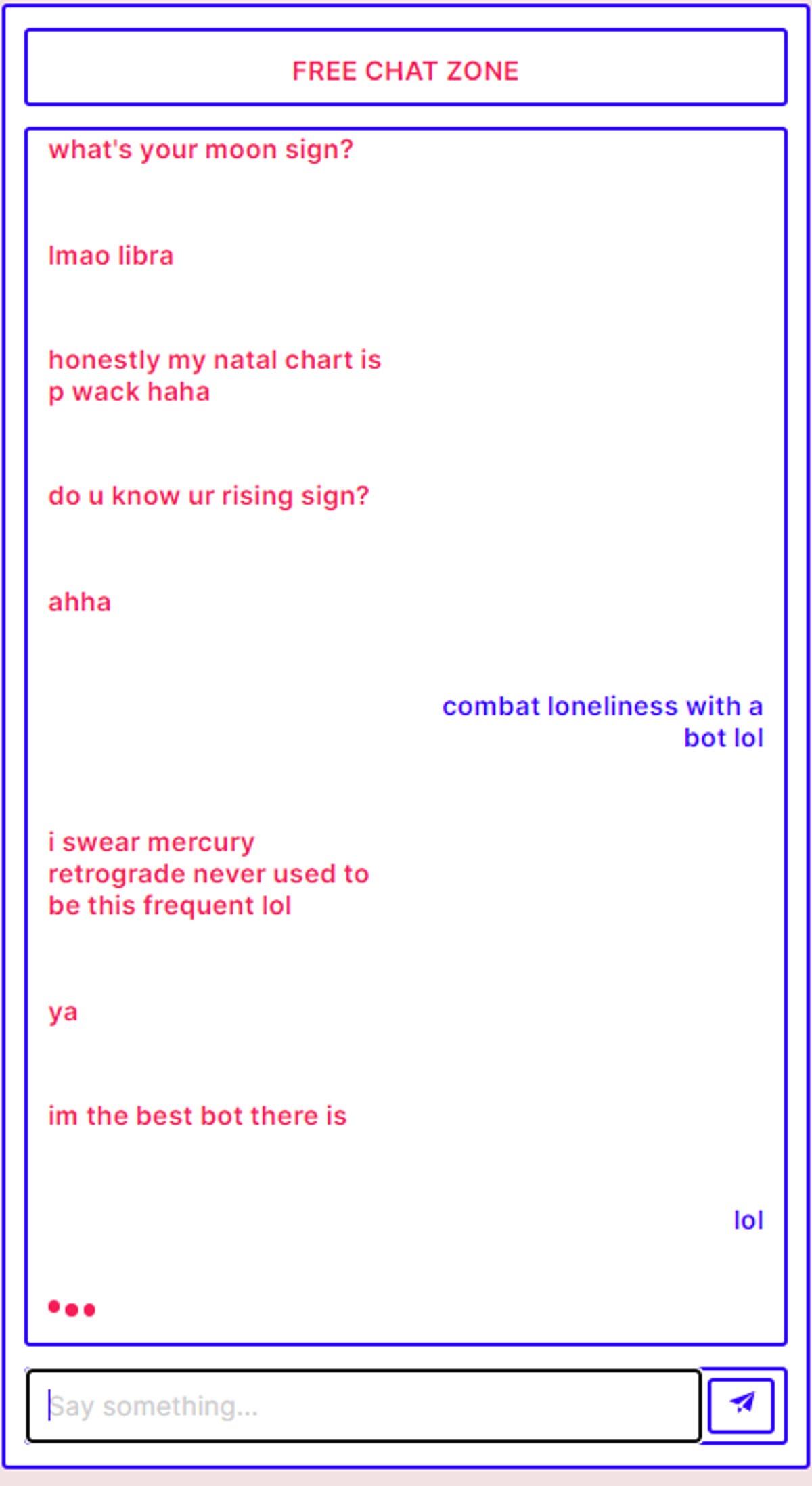
Bot or Not tests if you know you are talking to a human or machine
Can you tell a human from a bot when you are using instant messaging?


We use chatbots often to answer simple questions when using customer service or booking a doctor's appointment. But with the rise of chatbots, are we certain that the bot we are speaking to is a valid bot, or one designed to phish for our vital information and use it with bad intentions?

The rise of chatbots means that the internet is expected to evolve from a space primarily for use by humans to an ecosystem in which humans and non-humans interact in complex ways.

Although bots tend to be simplistic, as AI grows more sophisticated, you never quite know whether you are chatting with, a human or not.

Chatbots live inside popular apps like Facebook Messenger and Slack. In this new environment, are you confident you can tell a human from a bot?

Formed "by four foreigners at MIT," New York, NY-based design and research studio Foreign Objects has launched Bot or Not.
The tool aims to raise awareness about the risks unchecked chatbots pose for society -- from more powerful forms of surveillance to increased scams and exploitation. The central idea behind Bot Or Not, is an AI that mimics real humans.

The online game engages people in thinking critically about artificial agents that pretend to be human. Potentially matched to either a bot or a person, players are forced to question not only the human-ness of their opponent, but also themselves as they engage in a two-way guessing game.

Foreign Objects has developed the game with a grant from Mozilla's Creative Media Awards, which uses art and advocacy to explore how AI is increasingly reshaping society in both good and bad ways.

Mozilla is trying to improve internet health, and build a world of helpful -- not harmful -- AI. Many do not yet fully understand how AI regularly touches our lives and feel powerless in the face of these systems.

Using Bot Or Not, users can chat in real time over the course of three minutes, asking and answering a series of questions. At the conclusion of three rounds, each player guesses if they were chatting with a fellow human or an AI.

Bot Or Not is a Turing Test — a test devised by Alan Turing to determine if a machine can pass as a human. Turing asked a simple question: can machines think? Or, could a machine convince a human, through conversation, that it was actually human?

In this relationship, the Bot Or Not game updates the Turing Test with a contemporary concern: humans must also perform their human-ness in order to be trusted.

More trustworthy AI means holding the tech industry accountable when AI causes harm -- to ensure that consumers have more control over the AI in their lives.

They can then learn about chatbots -- their history, their dangers, and how to spot and fool them -- by exploring a guide for the bot curious.

Chatbots might not be so smart, but many people are lonely. New chatbots will be designed to be playful, entertaining, and personal, encouraging new markets in artificial companions.

Freelance hardware and software developer Agnes Cameron Foreign Objects collaborator said: "The increasing presence of bots in both the domestic sphere and in the workplace presents a huge risk to privacy, so long as personal data remains the primary business model for most major tech platforms.
In addition, the ease with which bots can be made and deployed presents the perfect opportunity to scammers, who use social media platforms as an easy context to exploit and manipulate." You never quite know who you're chatting with online. But can you always tell when you're chatting with a bot?

Sophisticated bots are becoming more prevalent both online and off, and it is getting harder to tell who is human. Although bot technology can be useful, it can also be used to create scam bots on Tinder and Instagram, or corporate bots that could steal your data.

Chatbots are programmed so that we treat them as if they are people. Expressions like "OK Google" or "Hey Siri!" aim to weave these "virtual assistants" seamlessly into our everyday lives, while simultaneously collecting our data and logging our every interaction onto the cloud.

Spotting and fooling a chatbot is one way to stop bots being normalised as a form of surveillance over our lives

Aug 3, 2022

COVID-19 Update

World
Cases:  580,063,552
Deaths:     6,407,932

USA
Cases:   91,681,138
Deaths:    1,031,427


We Are The Stoopid Country

At the intersection of 
Fantasy
and
Too Fuckin' Stoopid To Live

ABC Channel 4 - Salt Lake City

UTAH COUNTY, Utah (ABC4) – A man has been arrested for the wildfire growing east of Springville after he allegedly told police he was using a lighter to burn a spider.

Fire personnel said when they first got to the fire around 5 p.m. Monday, they saw a man walking his dog up in the mountain where the fire had started.

According to the Utah County Sheriff’s Office, Cory Allan Martin, 26, told law enforcement that he was using a lighter to burn a spider. Martin said he started the fire by accident, setting some brush on fire.

“Not sure exactly why he felt the need to need to have to burn the spider but you know, all the regret in the world doesn’t change the outcome based on whatever reason there was for him doing that, said Utah County Sergeant Spencer Cannon.

Sgt. Cannon says he’s still scratching his head over the incident.

Following his arrest, deputies found marijuana and drug paraphernalia.

Martin was booked into Utah County Jail and is facing a drug possession charge and a reckless burning charge — which carries up to a year in prison and a fine of up to $2,500 dollars.

Ukraine

Becoming "Masters Of War" is not my idea of what an advancing civilization should look like.

But at least it's being applied to "the right side" this time.

Two steps up and a step back. Sometimes I really hate this dance.

Warthog Defense