Oct 1, 2022

How Many Will That Make It?


Donald Trump has failed &/or gone broke more often than most people change their underwear.

A couple more are about to bite the dust.


Company That Organizes Trump’s Paid Speeches Is Going Broke

The American Freedom Tour, which struck a multimillion-dollar deal with Trump after he left office, has lost two top executives and canceled events in a number of locations as it has failed to pay its bills, according to people familiar with the activities and documents obtained by The Washington Post. Its founder and owner, who has a history of bankruptcy filings, recently sought bankruptcy protection again.

The group has promised events in a number of locales but canceled them before they began and appears to be banking on a large event at Mar-a-Lago in December to turn its financial position around.

The only people who have gotten paid are people close to Trump. The same company ran the big paid event arena tour that was a total disaster. It turns out that even Trump’s supporters were not willing to pay premium ticket prices to see Trump, his family, and various cronies.

Trump had to cancel a for-profit rally in North Carolina when he had to testify in the New York fraud investigation.

Trump tried a tour with Bill O’Reilly in 2021, resulting in thousands of empty seats.

As his legal woes mount, investors are bailing on Truth Social.

The post-presidency of Donald Trump appears to be one endless series of failed grifts. Donald Trump has overinflated the value of his brand to his fans, and anyone who did work for the former president without getting payment upfront is being left holding the bag.


Today's Keith


Paraphrasing Joe Stalin - "How many divisions does the Supreme Court have?"
(at about 12:15)

"Ignore the court" is somewhat overstating the case - it's Olbermann after all - but an important point.

Keith Olbermann Episode 44 - The Alito Court

Sep 30, 2022

Liberty

This kinda shit boils down to this: Republicans are so afraid of women being free to make their own decisions about what happens to their own bodies, they've started passing laws prohibiting people from even talking about abortion in public.


The nonsense about "cancel culture" gushing out of their pie holes has to be stomped on.


'Chilling effect on free speech': Idaho universities disallow abortion, contraception referral

Idaho universities are warning staffers not to refer students to abortion providers, and at least one public university is barring employees from telling students how to obtain emergency contraception or birth control as well. It’s the latest restriction in a state that already holds some of the strictest abortion laws in the nation.

“This is going to have a very broad impact,” said Mike Satz, an attorney and former faculty member and interim dean at the University of Idaho’s College of Law. “It’s going to have a very strong chilling effect on free speech and it’s going to scare people. I’m afraid it’s going to scare people from going to school here or sending their kids to school at Idaho institutions.”

The prohibition against referring students to abortion providers or “promoting” abortion in any way comes from the “No Public Funds for Abortion Act,” a law passed by Idaho’s Republican-led Legislature in 2021. Boise State University, like the University of Idaho, told faculty members in a newsletter earlier this month that they could face felony charges for violating the law. Idaho State University did not respond to phone messages from The Associated Press asking if it had issued similar guidance.

The law also bars staffers and school-based health clinics from dispensing or telling students where to obtain emergency contraception, such as the Plan B pill, except for in cases of rape. Emergency contraception drugs prevent pregnancy from occurring and do not work in cases where someone is already pregnant.

The University of Idaho’s guidance released Friday goes a step further, also warning employees about a law written in 1867, 23 years before Idaho became a state. That law prohibits dispensing or “advertising” abortion services and birth control — leading to UI’s advice that condoms be distributed only to prevent sexually transmitted diseases, but not to prevent pregnancy.

It’s not yet clear how the the law barring “advertising or promoting” abortion and birth control services could impact students or other state employees who may use state-owned computers or wireless networks to share information about how to access reproductive health care on Instagram or other social media sites. Scott Graf, a spokesman for Idaho Attorney General Lawrence Wasden, said his office planned to discuss the guidance given to university staffers and the abortion laws in an internal call Tuesday morning.

Jodi Walker, spokeswoman for the University of Idaho, said the university follows all laws and said UI officials were still “working through some of the details.”

“This is a challenging law for many and has real ramifications for individuals in that it calls for individual criminal prosecution,” she said of the public funds law. “The section does not specify what is meant by promoting abortion, however, it is clear that university employees are paid with public funds. Employees engaging in their course of work in a manner that favors abortion could be deemed as promoting abortion.”

Abortion can still be discussed as a policy issue in classrooms, Walker said, but the university recommends that the employees in charge of the class “remain neutral or risk violating this law.”

“We support our students and employees, as well as academic freedom, but understand the need to work within the laws set out by our state,” she said.

But that could be nearly impossible, said Satz. Both the University of Idaho and Boise State University rely on grants to fund major research and academic projects, and the federal government is among the largest sources of those grants. The federal government also provides abortions through the Veterans Administration, Satz noted, and the “No Public Funds for Abortion Act” bars the state from contracting with abortion providers.

Idaho’s lawmakers could fine-tune the laws to ensure they don’t violate 1st Amendment free speech rights or lead to major funding losses, but the deeply conservative state Legislature isn’t scheduled to meet again until January.

Boise State’s advisory to employees noted that abortion-producing medications or procedures can still be prescribed if they are used to remove a dead fetus caused by spontaneous abortion, to treat an ectopic pregnancy or to “save the life or preserve the health of the unborn child.” But some of those scenarios are gray areas under other state laws criminalizing abortions, including one targeted in a U.S. Department of Justice federal lawsuit against the state of Idaho.

Idaho isn’t the only state where employees have been cautioned not to give abortion advice. In the summer, librarians in Oklahoma City were warned against using the word “abortion,” though that changed after the city’s library team reviewed the laws. Still, social workers, clergy members and others have raised concerns in Oklahoma about being exposed to criminal or civil liability just for discussing abortions.

Compare & Contrast

Trae Crowder - The Liberal Redneck

On how the fuck are a few verbal gaffes the biggest problem we've got right now?

Sep 29, 2022

Today's Reddit


We have to get our asses off dirty fuels.

COVID-19 Update

Biden caught some well-deserved shit for saying "the pandemic is over".

It's widely agreed that the "pandemic part" of this thing is more or less behind us, and we're at the beginning of the "endemic part". He needed to say that second bit and he didn't.

So he had a dumbass moment.

Given everything the guy is dealing with, I'll let that one slide.


(pay wall)

Here’s Who Really Needs the New Covid Booster

The new US Covid booster campaign needs a dose of clarity about its goals and limitations. The latest “bivalent” vaccine — retooled to protect against the currently circulating BA.5 variant — will benefit some more than others. The oldest and most vulnerable citizens are likely to benefit most. Public health officials should aim to protect them through a targeted messaging campaign convincing them to get the shot. Younger people should only be encouraged to get it if they’re more than six months out from their last shot.

Right now, however, the Centers for Disease Control and Prevention has a broader focus — recommending that everyone over 12 get the booster if they’re more than two months out from their last shot or three months out from an infection. That diffuse message is less likely to reach those who need it most.

The situation was simpler during the initial vaccine rollout in 2021. The clinical trial data suggested that vaccinations would go a long way toward preventing infection in the first place, and so getting vaccinated was considered not just a personal health choice but a civic duty for everyone. There was broad scientific consensus that widespread vaccination would minimize cases and maybe even end the pandemic.

That hope was crushed by the discovery of immunity-evading new variants. But there was still a pretty wide consensus that people should get a first booster, thanks to growing evidence that an extra shot, given months later, would help reduce cases and prevent severe illness.

But expert opinion had splintered by the spring of 2022. Some wanted to keep boosting everyone every six months or so, either with the original vaccines or with updated boosters. The problem was a lack of evidence that repeated boosting would make a substantial dent in cases. The new bivalent BA.5 boosters could plausibly reduce the odds of infection, but we don’t know by how much.

“At the end of the day, probably what counts most is the time from the last immunization or infection,” says Alessandro Sette, a professor at the La Jolla Institute of Immunology. He says right now there’s too much emphasis on the number of boosters people are getting, rather than their timing. For four or six months after infection or a previous booster, your immune system probably isn’t very boost-able.

Sette reiterated what Harvard University immunologist Duane Wesemann told me for a previous column: Over the months following an infection or vaccine dose, your immune system is slowly improving the quality of your antibody-making B-cells and generating slight diversity that increases the odds of effectiveness against a new variant. The number of antibodies circulating in your bloodstream can decline, but these B-cells continue to retain the ability to make new ones pretty quickly for about six months.

That’s why University of California, San Francisco infectious disease doctor Monica Gandhi told me she’s been arguing that the recommended interval be six months for healthy people — not the two currently recommended (and in some places, mandated).

In principle, pushing forward a massive fall booster campaign could blunt a winter wave, but Covid waves can’t yet be predictably tied to seasonal changes, and nobody knows whether BA.5 or something else will be behind the next surge. It’s also unknown whether boosting someone earlier than about four months does anything to reduce the odds of infection and transmission.

The other essential question is whether the BA.5 bivalent booster has a significant advantage over the original boosters. Sette says the evidence points that way, as least as long as BA.5 remains dominant. In fact, Sette told me that he was going to go get his bivalent booster that same day, right after our interview was over.

But pediatrics professor and Food and Drug Administration advisory committee member Paul Offit is not planning to get the new booster just yet. He called the evidence that the bivalent booster was more protective than the original “underwhelming” and, in an opinion piece for the WSJ, accused the CDC of overselling it, when it’s most likely to benefit the oldest and most vulnerable.

A more targeted CDC messaging campaign would prioritize the 35% of people over 65 who haven’t been boosted at all; they’d benefit the most from the retooled booster. Next on the priority list would be the over-65s who haven’t been boosted or been infected during the last six months. Even if they already had one booster, there’s now evidence that getting a second booster reduces the risk of death, so a second shot is worth it. It’s less urgent to reach the two-thirds of adults aged 18-64 who’ve yet to get a single booster, although they’d also benefit, so long as they haven’t been infected in the last 4-6 months.

In a way, it doesn’t have to be more complicated than the original rollout, which emphasized certain people needed to be first in line: health care workers, essential workers, then older people, then younger people with health problems, and then everyone else.

This time around, public health should also rank people by urgency, starting with unboosted people over 65. Even if the overall uptake numbers stay low, the booster campaign can still save lives if it reaches the right people.

- and -
(new story, same pay wall)

Five things about covid we still don’t understand at our peril

Unlocking these secrets might arm us with strategies to protect ourselves and stop the next pandemic


Since a new coronavirus launched the global pandemic that has now killed more than 6.5 million people — 16 percent of them in the United States alone — scientists in record numbers have devoted themselves full time to unraveling its mysteries.

In less than three years, researchers have published more than 200,000 studies about the virus and covid-19. That is four times the number of scientific papers written on influenza in the past century and more than 10 times the number written on measles.

Still, the virus has kept many of its secrets, from how it mutates so rapidly to why it kills some while leaving others largely unscathed — mysteries that if solved might arm the world’s scientists with new strategies to curb its spread and guard against the next pandemic. Here are some of the most pressing questions they are trying to answer:

Where did the virus come from, and why has it been so successful?

Scientists have found very similar viruses in horseshoe bats living in remote caves in Laos, southern China, and other parts of southeast Asia. So far, though, no one has succeeded in drawing a line between the viruses in bats and the Huanan Seafood Market, which sold and butchered live animals in Wuhan, China, and where many scientists believe the virus first spilled over into people.

That theory is backed by multiple lines of evidence, including the clustering of early coronavirus cases around the market — documentation laid out in two peer-reviewed papers published this summer. But key details remain elusive. We do not know where in the market the leap from animals to humans took place, or which animals were involved. Nor do we know the precise steps in the process.

“What particularly drove that spillover?” asked Vincent Munster, chief of the virus ecology section at Rocky Mountain Laboratories, a research facility in Hamilton, Mont., that is part of the National Institute of Allergy and Infectious Diseases. “We’ve now identified 20 or 30 of these viruses that all look very similar, but they are not the same. What is the true hideout place of the progenitor of SARS-CoV-2?”

Several investigations have not been able to categorically rule out the possibility the virus escaped from a laboratory in China, although many scientists believe that is far less likely than that it jumped from animals as part of a natural process.

The entrance to the Huanan seafood market in Wuhan, shown in February 2021. (Getty Images)

Escape from a lab could involve at least two scenarios: one, in which the virus evolved in nature and was being studied by scientists; another in which the virus was created in the lab by researchers examining factors that might cause a coronavirus to become more deadly or more transmissible.

Scientists working at the Wuhan Institute of Virology, a major research center that studies coronaviruses, have denied ever having the virus in their laboratories, but that has never been corroborated by outside investigators because Chinese authorities limited access.

Whatever its origins, SARS-CoV-2 has proved far more successful at infecting large numbers of people than other coronaviruses, including the one that surfaced in Asia 20 years ago causing severe acute respiratory syndrome, a less contagious though also sometimes fatal illness. Both coronaviruses invade human cells through a spike protein that attaches to the ACE2 receptor on the surface of human cells. Yet the trajectories of the two pathogens could hardly be more different.

The original SARS, which emerged in China in late 2002, sickened 8,098 people, killing 774. But that outbreak was over within a year, in large part because of 19th-century public health measures such as social distancing and isolation of the infected — many of the same steps public health officials have urged during the current pandemic.

However, SARS patients, unlike those in this pandemic, “are most likely to be contagious only when they have symptoms, such as fever or cough,” according to the Centers for Disease Control and Prevention. That made it easier to identify and isolate them.

Resolving the uncertainties surrounding how SARS-CoV-2 was first transmitted to people and why it has thrived are “extraordinary questions,” Munster said, “because they would actually tie back to preparation for the next pandemic, which everybody is worried about.”

How is the virus evolving, and will there be new variants?

Early on, scientists delivered a seemingly comforting message about coronaviruses, the family to which SARS-CoV-2 belongs: Other viruses acquire mutations more frequently, making them more difficult to keep up with and raising the possibility they will develop more contagious or deadly versions. Coronaviruses have their own proofreading system that helps limit mutations as the virus makes copies of itself.

But the reassuring message was soon followed by a parade of Greek letters ― alpha, beta, delta, now omicron ― signifying new, more contagious and occasionally more lethal variants of the virus. These variants are able to dodge the disease-fighting antibodies that protect people after being infected or vaccinated.

At least some of the virus’s rapid evolution has occurred inside the bodies of severely immunocompromised patients, where it was able to linger, replicate and mutate for months.

“We know that, unfortunately, immunocompromised people are a major breeding ground for these noxious variants because of the accelerated evolution of the virus inside them,” said Eric Topol, a professor of molecular medicine at Scripps Research Institute in La Jolla, Calif. “With all of the tens of millions of immunocompromised people around the world, the one that gave birth to omicron — what was it about that person?”

Because vaccination can pose a risk to some people with weakened immune systems, some did not get the shots, leaving them vulnerable to the virus and especially to long illnesses. The longer the virus remains inside a person, the more copies of itself it makes, each one offering a fresh chance to develop a mutation.

“But the language of the virus, the way it really comes up with ways to hurt us and infect us, and hijack our cells,” said Topol, “it’s always ahead of us. And then we say, ‘Oh, that’s how it did it.’

“But we haven’t cracked its code.”

It is unlikely the virus has finished mutating or churning out new variants. Scientists believe it will continue evolving to become better at escaping the human immune system. But researchers are uncertain what future variants might look like.

“The virus is becoming more infectious but less dangerous for the majority of people,” said Bill Powderly, co-director of the Division of Infectious Diseases at the Washington University School of Medicine in St. Louis. “But we’ve no guarantee that the virus wouldn’t develop additional mutations that would eventually make it more virulent in the future.”

An additional concern is whether animals infected with the coronavirus might become reservoirs for the evolution of new variants that might jump back into humans. As of January, according to a report, the virus had already been found in 29 other mammals. To date, incidents of animals infecting humans are rare. But some scientists fear that if the virus continues to spread to new species, it might pick up mutations as it adjusts to the environment inside those animals and then transmit potentially more dangerous variants back to humans.

Can we develop a coronavirus vaccine that will protect against future variants?

The swift development of vaccines to protect against severe illness and death from covid-19 has been hailed as one of the great scientific achievements of this century. But the vaccines did not, as some had hoped, bring the pandemic to an end. They provided protection against severe illness and death, but not infection and transmission, especially after the arrival of the more transmissible delta and omicron variants.

“They’ve been extremely effective, but they also have their shortcomings,” said Mark Siedner, an infectious-disease doctor at Massachusetts General Hospital. “Immunity wanes, and their ability to protect us against newer variants has been variable — in some cases quite strong, in other cases not as good as we’d like.”

Even people who were fully vaccinated have become infected with the latest iterations of the virus. The United States still records more than 50,000 new daily infections and 400 deaths daily, according to seven-day averages compiled by The Washington Post.

While new booster shots targeting both the original strain of the virus, as well as the now-dominant omicron subvariants, were authorized in late August by the U.S. Food and Drug Administration, some argue that reconfiguring vaccines to match the last variant will always put us one step behind the virus.

Jeffrey Shaman, director of the climate and health program at the Columbia Mailman School of Public Health, said the goal should be to develop a comprehensive vaccine that could protect against every version of SARS-CoV-2 — those we know about and those still to come.

“Can we develop a universal vaccine, effective across all existing and forthcoming variants, that confers sterilizing immunity — in other words, that prevents infection altogether?” he said.

Developing such a vaccine poses challenges, acknowledged Stuart Cohen, chief of infectious diseases at UC Davis Health. In the meantime, “the beauty of [existing] RNA vaccines is that they can modify them very quickly,” he said.

Scientists developed the mRNA vaccines by examining the part of the virus that has the most contact with the cells in our immune system — commonly referred to as the spike protein. “But the problem with these variants is that this is the exact part of the virus that is changing the most,” Siedner said.

The newly configured booster shots focus on the spike protein, too, but use two versions of it: one from the original strain identified in Wuhan and another from the omicron variant.

One strategy researchers are hoping will improve vaccines is to target them not only to the virus’s spike protein, but to other viral proteins as well.

Another potential improvement in the pipeline is development of a nasal-spray vaccine inhaled through the nose. “Maybe these will work on the respiratory tract more,” said Bernard Camins, medical director for infection prevention at the Mount Sinai Health System. “But we don’t know that yet.”

For the near term, Siedner said, we may need to modify vaccines the way we do with influenza, by changing them each year.

That idea was recently shared by White House coronavirus coordinator Ashish Jha, who said Americans should prepare to receive an annual booster shot against covid just as they do with the flu. Ideally people could be immunized against the coronavirus and flu during the same medical visit, he said.

Why do some people develop long covid?

About 1 in 5 covid-19 survivors in the United States, including some who were never very sick as a result of their infections, go on to develop long covid, according to the Centers for Disease Control and Prevention.

The condition itself is one huge question mark — a persistent illness marked by a variety of symptoms including fatigue, fever, shortness of breath, chest pain, pounding heartbeat, headaches, difficulty thinking or concentrating, dizziness and joint pain.

“What are the drivers, and what are the causes?” said Gary Gibbons, director of the National Heart, Lung and Blood Institute, part of the National Institutes of Health. “We see the phenomenon in terms of all these symptoms, but why? What’s generating them?”

To develop treatments, researchers must answer such questions. For example, the condition may be caused by virus hiding out in the body, even after acute infection passes. If that is the case, Gibbons said, the answer may be using antivirals to clear more or all of the virus from the body.

Another theory is that minute blood clots, remaining after the viral assault or fueled by the body’s response, continue to have a punishing effect on different parts of the body.

A third notion is that the symptoms are caused not by the virus, but by an immune system gone haywire.

The disease “has a hidden burden,” said Maria Elena Bottazzi, associate dean of the National School of Tropical Medicine at Baylor College of Medicine. She said the long-term effects on the brain, including brain fog and mental health complications, bear some similarity to those of Lyme disease, which is transmitted by infected ticks.

In December 2020, Congress approved spending more than $1.1 billion to study long-term effects and possible treatments for covid-19 and long covid. So far, the project has awarded $37 million to 40 research studies, but millions of sufferers say they have yet to find meaningful treatments.

Why does covid severity differ by age and from one person to another?

When deaths from covid-19 are charted by age, they form a ladder. The younger the patient, the less risk of severe illness or death.

Worldwide, children and adolescents under the age of 20, account for just 0.4 percent of all the deaths from covid-19, according to UNICEF.

“Young kids, even really young kids, are much less susceptible to severe disease than older people,” said Stephen Goldstein, a postdoctoral fellow studying coronaviruses at University of Utah.

“If you’re 40, your absolute risk is still pretty low, but it’s much higher than somebody who’s 5. Why is it better to be 1 than 50? I mean, a 1-year-old with influenza, that’s bad.”

The opposite was true in the 1918 flu pandemic, when the highest mortality rates were in children 5 and under, adults 20 to 40 and seniors 65 and older. In the 1957 flu pandemic, the highest death rates were among children 5 and under and seniors 65 and over.

Even within the same age group, SARS-CoV-2 can have vastly different outcomes, killing one patient while sparing another of the same age who appears to have a similar health profile. Scientists believe that genetic factors and the amount of virus someone has in their body may influence the severity of their illness, but how some of those factors play out is still largely unknown.

What is clear is that the human immune system declines as we age, leaving older people more vulnerable to pathogens. Also, covid-19 presents a greater risk for severe illness to people already afflicted with some of the most common diseases of aging such as cancer, chronic lung diseases, heart disease and stroke.

Goldstein said the differing responses to the virus between the young and the old may have something to do with interferon, a protein that alerts the body’s natural immune system. “Maybe kids make more interferon, and maybe they make it earlier,” Goldstein speculated. “I think that’s probably the key.”

A report in Nature examined differences between the immune systems of adults and children, and found that cells in the airways of healthy children were already in an “interferon-activated state,” and ramped up further after infection with the coronavirus.

The researchers suggested that those innate interferon responses in children restrain the virus and progression of the disease.

Other scientists have suggested that children’s developing immune systems have lower levels of the proteins that can cause the potentially deadly immune response known as a cytokine storm. Another possible explanation is that children have more of the master cells capable of repairing damaged lungs.


Today's Sportsball

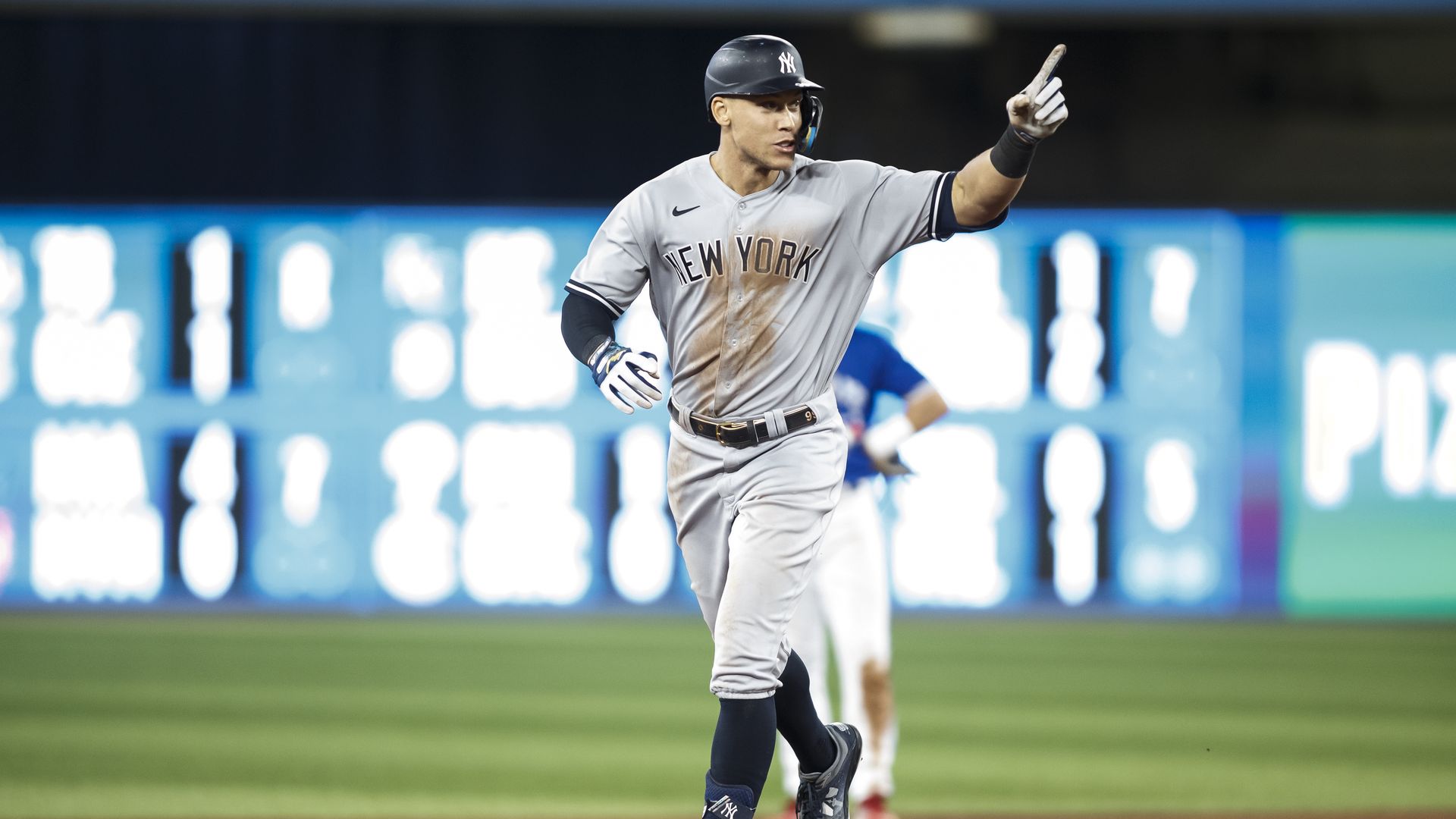
This is absolutely newsworthy. The only thing that rankles a little is that they always have to mention the contract, and steroids.

Everything comes with a fucking asterisk.

I get it - there's always the element of transaction, and there are caveats that apply. I just wish we could let the guy do what he does - marvel at it - and forget about all the other shit for one short minute.

Aaron Judge. Photo by Cole Burston/Getty Images


Yankees Aaron Judge ties single-season AL record with 61st home run

Yankees outfielder Aaron Judge hit his 61st home run on the season on Wednesday night, tying the longtime American League record set by Roger Maris in 1961.

The big picture:
  • Judge continues an electric season, batting .314 with 173 hits and 130 RBI to go with his home run total.
  • Behind Judge, the Yankees clinched the AL East on Tuesday against the Blue Jays.
By the numbers:
  • Only five other players — Maris, Barry Bonds, Mark McGwire, Sammy Sosa and Babe Ruth — have hit 60 or more home runs in a single season.
  • But McGwire has admitted to steroid use while Bonds and Sosa have denied allegations that they used performance-enhancing drugs.
Between the lines:
  • Judge's monster season comes before he enters free agency.
  • The four-time All-Star turned down the Yankees' seven-year, $213.5 million extension offer and wouldn't negotiate during the season, preferring to focus on the "job on the field," ESPN reports.
  • The Yankees have said they intend to keep Judge in New York.

Sep 28, 2022

Something I Learned Today

While reading about the 10 year anniversary of "Pitch Perfect", I learned there's a thing called The Bechdel Test.


And the Reverse Bechdel is:
Two men
talk to each other about
nothing but women

BTW, Pitch Perfect is a personal fave for me - something special about a cappella, and something extra special about lady voices singing a cappella.

This one makes me cry.


Here's Millie Mae Healy's piece in yesterday's Harvard Crimson:

‘Pitch Perfect’ at 10: ‘Not Like Other Girls’

“Pitch Perfect” has a difficult legacy. It’s a wonderful, hilarious, and empowering film that by all accounts should have been an offensive fail. Ten years on, its flaws are more obvious than ever, but it also stands out as a triumph of late-2000s comedies.

The biggest weakness in “Pitch Perfect” is its laziness. There’s a misogynistic radio host, and that’s the entire joke. Consistently, there is a reliance on harmful stereotypes in constructing characters who are racial minorities or queer. All in all, this should culminate in a really redundant, stale, and derivative rom-com, but somehow it gets two things really, really right.

First, “Pitch Perfect” is not a musical. All of the music is diegetic; it’s actually happening in real time for the characters. They don’t wail and dance about their feelings; they yell at each other like contemporary people in the real world. But in addition to the great vocal performances and iconic cover choices, the music is a great vehicle for the plot. The a cappella group the Barden Bellas sound discordant when they are struggling to mesh as a group. Their use of “Hit Me With Your Best Shot” and “S&M” in the Riff Off are iconic even today, and deftly establish the world and community of a cappella in the film. The audition scene is particularly spectacular for this: The rendition of Kelly Clarkson’s “Since U Been Gone” holds up today while also doing an incredible amount of legwork to establish all of the minor characters and the role of a cappella on this college campus. The music adds another dimension to what would otherwise be a college comedy, creatively providing an avenue to express the characters’ feelings and growth, as well as being engaging in its own right.

Secondly, “Pitch Perfect” successfully utilizes an unlikeable protagonist to create a story about female solidarity and kinship. The protagonist Beca, played by Anna Kendrick, sucks. She’s obnoxious, self-centered and judgemental. She’s sullen about getting a free college education because she’s mad at her dad for not funding her real dream, which is to head to L.A. by herself with no plans. She looks down on other characters for having interests and caring about things, and only deigns to join the Barden Bellas because her dad makes her. Because she’s the super special protagonist, co-head of the Bellas, Chloe (Brittany Snow), desperately wants her to join. Though she has some valid criticisms of Bella traditions, her refusal to participate and engage means she can’t have a positive impact on the group.

Yet, after self-destructing all of her relationships, Beca is made to reckon with her attitude and also her actions. She admits that she cares about something and that she wants to be a part of this group. And after everything, the revelation is simple: She’s just like other girls. Once Beca gets over herself and respects her friends and the institution she wants to belong to, she’s able to positively contribute and help lead the Bellas into the future.

But more than that, despite the toxicity that makes their relationships so compelling, the female characters care about each other as people. Yes, unfortunately this is a notable bar. It passes the Bechdel test with flying colors — and passes the reverse Bechdel test too. Despite having a romantic subplot, the focus is still on the dysfunctional, fun, and complex relationships between these women who love to sing. Thanks to the music, and the unapologetic focus on a group of young women engaging in an off-beat niche that they happen to love, there is a substance to this film that is just lacking in a lot of comedies. It has something to say, and it does so in an imaginative way that is joyful to watch.

“Pitch Perfect” remains extremely watchable today, and is genuinely hilarious for most of its runtime, so it’s a shame that it has some glaring flaws. And it’s a shame the sequels course-corrected in the wrong direction.

Today's WTF


There's a double whammy effect on way too many aspects and revelations of Trump's fuckery and flat-out stoopid ineptitude.

The first WTF is the fact of his doing, or wanting to do, something horrendous. And the second one is the fact that Press Poodles know about all this shit, but wait to tell us about it until they can get their fucking books published.

I'd like to think we'll get this shit straightened up eventually, but it's looking like we won't get back to a decent "normal" for a quite a while.

In the meantime, we can look forward to more stories about the weird shit that Trump - and all those best people he surrounds himself with - thought were good ideas.

😱 Like bombing Mexico!?! ðŸ˜¡

(pay wall)

Trump weighed bombing drug labs in Mexico, according to new book

The 607-page ‘Confidence Man,’ from New York Times reporter Maggie Haberman, details unusual and erratic interactions between Trump and world leaders, members of Congress and his own aides


As president, Donald Trump weighed bombing drug labs in Mexico after one of his leading public health officials came into the Oval Office, wearing a dress uniform, and said such facilities should be handled by putting “lead to target” to stop the flow of illicit substances across the border into the United States.

“He raised it several times, eventually asking a stunned Defense Secretary Mark Esper whether the United States could indeed bomb the labs,” according to a new book by New York Times reporter Maggie Haberman. White House officials said the official, Assistant Secretary for Health Brett Giroir, often wore his dress uniform for meetings with Trump, which confused him.

“The response from White House aides was not to try to change Trump’s view, but to consider asking Giroir not to wear his uniform to the Oval Office anymore,” Haberman writes in “Confidence Man,” an extensive book about Trump’s time in New York and as president.

The 607-page book, which has long been awaited by many of Trump’s aides, is set to be published Tuesday. A copy was obtained by The Washington Post. The book details unusual and erratic interactions between Trump and world leaders, members of Congress and his own aides, along with behind-the-scenes accounts of his time as a businessman.

Presented with a detailed accounting of the book’s reporting, a Trump spokesman did not directly respond. “While coastal elites obsess over boring books chock full of anonymously-sourced fairytales, America is a nation in decline. President Trump is focused on Saving America, and there’s nothing the Fake News can do about it,” said Taylor Budowich, the spokesman.

When asked by The Post about the account of the Oval Office discussion, Giroir said in an email that he does not comment on such private conversations with Trump. He went on to criticize the flow of drugs across the border from Mexico and voice support for substance abuse treatment. “But these measures will not stop this mass murder of Americans,” he added. “Every option needs to be on the table.”

Haberman interviewed Trump three times for the book — in which he claimed to not have taken any important documents from the White House, among other statements — and it includes his written answers to her questions. The book delves into some of the most contentious episodes of his presidency, including his impeachment trials, the weeks after the election when he tried to overturn the results and his mishandling of the novel coronavirus, among other topics.

Throughout the book, Trump is portrayed as transactional and narcissistic — at times charming, at other times cruel — but always attuned to his own political fortunes, no matter the issue. During his meeting in the Oval Office with Barack Obama in 2016, he eschewed policy and asked Obama how he kept his approval ratings high, according to the book. He told advisers that he needs people such as Pennsylvania Senate nominee Mehmet Oz (R) in office in case the election is challenged in 2024 or they try to impeach him again.

When Trump first met British Prime Minister Theresa May, he soon turned the conversation to abortion. “Some people are pro-life, some people are pro-choice. Imagine if some animals with tattoos raped your daughter and she got pregnant?” he said, according to the book. Pointing to then-Vice President Mike Pence, he described him as the “tough one” on abortion. He soon moved the topic away from Northern Ireland to an offshore wind project he wanted to block near his property, the book says.

Trump was often crass and profane about world leaders and others in his orbit. He referred to German Prime Minister Angela Merkel as “that b----,” according to the book. When Ruth Bader Ginsburg was dying in 2020, the book says, Trump would sarcastically raise his hands to the sky in prayer and say: “Please God. Please watch over her. Every life is precious,” before asking an aide: “How much longer do you think she has?”

When former New Jersey governor Chris Christie (R) pressed Trump to more forcefully condemn white supremacists, particularly avowed white supremacist David Duke, during his 2016 campaign, Trump said he would — but he was in no rush. “A lot of these people vote,” Trump said, describing some of the white supremacists, before ending the call.

The book shows Trump frequently praising Russia and its president, Vladimir Putin, for his strength and even “laughing” when aides grew mad that he tweeted a proposal for a joint cyber unit with Russia that would have “effectively let the Russians into the U.S. investigations of hacking,” Haberman writes.

In another part of the book, Trump shows his lack of care about classified markings. Aides tried to stop Trump from tweeting a photo of an Iranian facility until they could remove classified details, Haberman writes. But he liked how the image looked and proceeded. “If you take out the classification, that’s the sexy part,” he told aides, she writes.

And as Trump played down the coronavirus in early 2020, he privately acknowledged its severity and cast himself as the victim, according to Haberman’s book.

“Can you believe this happened to me?” he said, fearing the political impact on his presidency.

In detail, Haberman reports how Trump was fearful of dying and how his condition grew worse in the White House. “Deputy chief of staff of operations Tony Ornato warned the president that if he fell into a more dire situation, procedures to ensure the continuity of government would have to be set into motion,” Haberman writes.

Trump was appalled by the sight of protective face masks, telling aides to remove them in his presence throughout 2020. “Get that f---ing thing off,” he said during one meeting, according to Haberman’s book. Trump repeatedly wanted credit for vaccines but told aides he could not get the credit he deserved because of the “radical right,” referring to his own supporters.

He repeatedly encouraged aides to avoid the topic of the coronavirus because he viewed it as a political loser for him. “Don’t talk about it on TV,” he told the Republican National Committee’s chairwoman, Ronna McDaniel, according to the book, even as the virus dominated the news. “Don’t make such a big deal out of this,” Trump said of the pandemic in one March 2020 conversation with then-Gov. Andrew M. Cuomo (D). “You’re gonna make it a problem.”

The book shows frequent attempts from advisers to tell Trump to tone down his behavior, fearful that he was going to lose his reelection bid because of his own personal conduct. He was repeatedly shown polling that his coronavirus news conferences were hurting him, in an attempt to get him to take the virus and his response more seriously.

“People are tired of the f---ing drama,” Attorney General William P. Barr told him in 2020. Barr was one of a number of aides who urged Trump to dial back his frequent attacks on others.

The book also shows how Trump regularly pitted aides and even family members against one another in the White House. For example, Trump frequently told then-White House Chief of Staff John F. Kelly that he wanted Jared Kushner and Ivanka Trump to depart the White House, according to the book.

“In meetings with Kelly and [White House Counsel Don] McGahn, Trump gave instructions to essentially fire the pair. Kelly and McGahn resisted, expressing their fear that he would not back them once his daughter and son-in-law pushed back. At one point, Trump was about to write on Twitter that his daughter and son-in-law were leaving the White House. Kelly stopped him, saying Trump had to talk to them directly before doing so. Trump agreed, then never followed up with the conversation,” the book says.

Trump gave former New York mayor Rudy Giuliani (R) control of his legal team because his other lawyers were not willing to go far enough to overturn the 2020 election, Haberman writes. “Okay, Rudy, you’re in charge. Go wild, do anything you want. I don’t care,” Trump said over the phone, as he pushed him to help overturn the results. “My lawyers are terrible.” He frequently berated White House counsel Pat Cipollone, according to the book.

In the aftermath of the election, Haberman describes a president who increasingly became enamored with conspiracy theories and staying in the White House, bringing in lawyers whom his core group of advisers saw as deluded — with some of his longest advisers effectively trying to hide and run out the clock.

And it shows how he relishes his role as a political kingmaker in the GOP. During one of her interviews with Trump, Haberman writes that Sen. Lindsey O. Graham (R-S.C.) came in and praised his golf game. “‘The greatest comeback in American history!’ Graham declared. Trump looked at me. ‘You know why Lindsey kisses my ass?’ he asked. ‘So I’ll endorse his friends.’ Graham laughed uproariously.”

More than many tomes about Trump, the book delves into his long history as a developer in New York, where Haberman talked with many of his former friends and executives about his tendency to speak in crass terms about women and skirt financial laws — and how he created a mystique around him that endured to the presidency.

Haberman traces Trump’s political career back to the 1980s, where she reports he frequently made comments that were homophobic, particularly toward gay men, and washed his hands immediately after meeting someone who had AIDS.

She describes Trump’s complicated relationship with his father and the ways they avoided paying taxes over the years. She writes that Trump mused about wanting Black judges for his cases because his late lawyer Roy Cohn said they could be manipulated. Even as a businessman, she said, he was looking at politics, getting polling presentations on his image as early as 1987.

Some of the book’s episodes border on the bizarre.

Haberman describes Rep. Debbie Dingell (D-Mich.) getting a phone call from an unknown number. “When she answered, the man on the other end identified himself as a Washington Post reporter, and said he knew her husband from his investigations in Congress. The name he gave was not one she recognized. The man asked Dingell if she was looking for an apology from Trump. No, she replied, merely that people could be civil to one another. As the man talked, Dingell couldn’t shake the idea that his voice sounded like that of the forty-fifth president.”

“During preparations for the third debate in 2016, Hillary Clinton’s team was disrupted by a warning from the husband of Sen. Dianne Feinstein (D-Calif.), who said he had been told that Russians might try to poison Clinton through a handshake with Trump, to inflict a dramatic health episode during the debate,” Haberman reports.

She says Clinton did not take it seriously, and now-White House Chief of Staff Ron Klain, who was helping with debate prep, questioned whether Trump could poison Clinton but not himself. “Her communications director, Jennifer Palmieri, took the prospect seriously enough to check it out; the warning turned out to be mere speculation from a historian with no knowledge of Russian plans,” she says.

Haberman, a longtime Trump chronicler, concludes that Trump often says what he needs to get through the day — and that many people read more deeply into his motivations than he even knows at the time.

When asked if he is glad he ran for the presidency, Haberman suggests the answer reveals his motivations: “The answer is, yeah, I think so. Because here’s the way I look at it. I have so many rich friends and nobody knows who they are.”

In the book’s final pages, Haberman reproduces several pages of Trump’s answers to her questions for the book. He sent back pages in all capital letters, handwritten in marker, “two weeks after the deadline had passed,” Haberman said.

“A FANTASY QUESTION!” he responds to a question about Trump having gold bricks wheeled into his office in the 1990s. “KNOW NOTHING ABOUT IT,” he wrote in response to a question about delaying the transition to the Biden administration. “ACTUALLY THERE IS SOME TRUTH IN THAT,” he said to a question about him describing Melania Trump to others out of “central casting.”

The book closes with Trump, in black all caps, responding to a question: “FAKE NEWS — GOOD NIGHT!”

Sep 27, 2022

Ukraine


News from Russia, where it's been reported that searching on "how to break my leg" is now a top Google item:

⚠️ NSFW - look away at the end. ⚠️